Ponte Pietra, Verona
Bridge and Historic Site in Verona

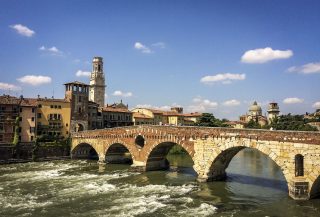
Ponte Pietra is Verona's beautiful stone bridge across the Adige, and it feels like one of those places where the city's history is simply “there” in front of you, no ticket required. It sits on a natural crossing point of the river and connects the old town to the hillside side of Verona, making it as practical for locals as it is scenic for visitors.
It's one of the top sights in Verona because it delivers instant atmosphere: layered Roman and medieval fabric, river reflections, and a skyline that looks especially good at sunrise and blue hour. It also fits neatly into a walking tour of Verona, since you can cross the bridge, loop up toward the Roman Theatre or viewpoints above, and return to the central piazzas without needing transport.
Table of Contents
- History and Significance of the Ponte Pietra
- Things to See and Do in the Ponte Pietra
- How to Get to the Ponte Pietra
- Practical Tips on Visiting the Ponte Pietra
- Where to Stay Close to the Ponte Pietra
- Is the Ponte Pietra Worth Visiting?
- For Different Travelers
- FAQs for Visiting Ponte Pietra
- Nearby Attractions to the Ponte Pietra
History and Significance of the Ponte Pietra
Ponte Pietra dates back to Roman Verona, completed around 100 BC as part of a strategic river crossing on the Via Postumia, the major route linking Genoa to Aquileia. As the city expanded, the bridge became a key connector between the right bank, where the Roman city centre developed, and the east bank, where the Roman Theatre sits against the hillside.
The bridge you see today is a layered monument rather than a single “pure” Roman structure. Over centuries it was repaired, rebuilt, and adapted, including significant medieval work that kept the crossing functional and defensible, reflecting how Verona’s rulers used infrastructure as both a civic tool and a statement of control.
Its most dramatic modern chapter came during World War II, when several arches were destroyed by retreating troops. The post-war reconstruction in 1957 used recovered original stones and bricks, so the bridge remains a rare example of a monument rebuilt with a strong commitment to material continuity, rather than replaced with a clean modern replica.
Things to See and Do in the Ponte Pietra
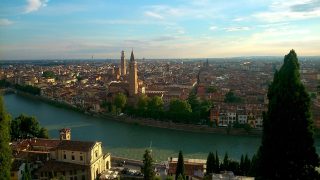
Walk it slowly, then stop mid-span and look both ways along the river. Upstream and downstream views show why Verona’s river bends matter to the city’s shape, and you’ll notice how the bridge frames rooftops, church profiles, and the green rise of the hillside across the water.
Cross to the east bank and use Ponte Pietra as your gateway to a slightly different Verona. This side feels more local and residential, and it's the natural starting point for the Roman Theatre area or for heading uphill toward panoramic viewpoints that look back over the historic centre.
Visit twice if you can: once in daylight for the “classic” postcard scene and once after dark when the lights catch the arches and the river turns glossy. Even if you're not chasing photos, the evening walk often becomes one of those unexpectedly memorable moments of a Verona trip.
How to Get to the Ponte Pietra
The nearest airport is Verona Villafranca Airport (VRN), with additional options via Bergamo (BGY) and Venice Marco Polo (VCE) if you are combining cities. For the best deals and a seamless booking experience, check out these flights to Verona on Booking.com. From the airport, travel into central Verona by shuttle/bus or taxi, then walk toward the historic centre and the river.
If you arrive by train, you'll come into Verona Porta Nuova, then continue into the old town by bus or on foot before heading to the Adige and the bridge. Use Omnio to easily compare schedules, book train tickets, and find the best prices all in one place for a hassle-free journey across Italy. Once you are in the pedestrian core around Piazza delle Erbe and the Duomo area, reaching Ponte Pietra is a simple, signposted walk.
City buses are useful if you want to save steps from the station or the Arena area, but the last approach is always on foot through central lanes.
If you are traveling by car, park outside the historic core in a garage and walk in, since the centre is easier on foot and driving is limited by ZTL rules and narrow streets. If you are looking to rent a car in Italy I recommend having a look at Discover Cars, first, as they compare prices and review multiple car rental agencies for you.
Practical Tips on Visiting the Ponte Pietra
- Entrance fee: Free
- Opening hours: 24 hours
- Best time to visit: Early morning for soft light and fewer people, or after dark when the arches and river reflections feel most atmospheric.
- How long to spend: 10-30 minutes for a satisfying stop, longer if you’re pairing it with the Roman Theatre side or hillside viewpoints.
- Accessibility: The crossing is straightforward and mostly flat, but the stone surface can be uneven and slippery when wet.
- Facilities: There are no dedicated facilities on the bridge itself, so plan cafés and restrooms around the nearby centre streets and piazzas.
Where to Stay Close to the Ponte Pietra
For a culture-heavy itinerary, base yourself in the Centro Storico around Piazza delle Erbe so you can walk to Verona's main sights early; for quieter evenings and quick river-and-hillside strolls, Veronetta and the Ponte Pietra side of the centre are ideal.
If you want a stay that keeps you right in the old-town lanes with an easy walk to the bridge, Due Torri Hotel is a classic high-comfort base in the historic core. For a boutique feel close to the central pedestrian streets, Hotel Gabbia d'Oro places you within an easy loop of Ponte Pietra, Piazza delle Erbe, and the cathedral area. If you prefer to be virtually at the bridge for early-morning light and quick crossings to the Roman Theatre side, Relais a Ponte Pietra is hard to beat for location.
Is the Ponte Pietra Worth Visiting?
Yes, because it's a “high reward, low effort” Verona stop that gives you history and views in the same glance. It's also one of the rare places where Verona's layers are immediately readable: Roman foundations, medieval interventions, and a careful post-war reconstruction that still feels authentic rather than staged.
Even if your time is tight, Ponte Pietra works as a perfect connector in your day. You can treat it as a scenic crossing between neighbourhoods, or as a deliberate pause for photos and perspective before you dive back into the piazzas.
What Other Travellers Say...

Ponte Pietra, on Via Ponte Pietra in Verona, is a scenic Roman arch bridge rebuilt after wartime destruction; visitors praise it as a must-see spot for golden sunset views over the Adige, enjoyable evening strolls and photography, and a romantic place to end the day. Reviewers note striking vistas from nearby castle viewpoints, convenient walking access toward the town hall, and a lively surrounding area with good bars, top restaurants and even an ice cream shop sharing the bridge's name.


For Different Travelers
Families with Kids
For families, Ponte Pietra is an easy win because it's outdoors, free, and naturally engaging without a long attention span requirement. Kids usually enjoy the simple “mission” of crossing the river, watching the current, and spotting landmarks on both sides.
Pair it with a short climb or a quick stop on the Roman Theatre side so the bridge becomes part of a mini-adventure rather than a stand-alone photo stop. It also works well as a reset between busier, more crowded central sights.
Couples & Romantic Getaways
For couples, this is one of Verona’s most naturally romantic places because it doesn’t try too hard. The bridge is made for slow walking, shared views, and that classic moment when you pause mid-span and the city suddenly feels quiet.
If you want the best mood, come back after dark when the lights reflect on the Adige and the centre looks softly lit from the waterline. It’s an ideal pre-dinner walk that feels intimate even in a popular city.
Budget Travelers
Budget travelers should prioritise Ponte Pietra because it delivers a signature Verona scene at zero cost, and it anchors several excellent free walking routes. Once you've crossed, you can build a whole low-cost afternoon around river views, hillside lanes, and the return loop through central squares.
Use it as your “orientation point” for the day. When you can picture where the river is and how the centre sits above it, you naturally waste less time doubling back.
FAQs for Visiting Ponte Pietra
Getting There
Tickets & Entry
Visiting Experience
Photography
Accessibility & Facilities
Food & Breaks Nearby
Safety & Timing
Nearby Attractions to the Ponte Pietra
- Teatro Romano: Verona's Roman theatre on the east bank, a classic pairing with the bridge for a strong ancient-history loop.
- Duomo di Verona: The cathedral complex is a short walk away and adds a rich, quieter sacred-architecture stop to your route.
- Piazza delle Erbe: Verona's liveliest square, perfect for a post-bridge coffee and a quick hit of old-town energy.
- Torre dei Lamberti: The best central viewpoint if you want to add a skyline panorama after your river-level photos.
- Castel San Pietro viewpoint: A hillside lookout above the river that rewards a short climb with one of Verona's most iconic panoramas.
The Ponte Pietra appears in our Complete Guide to Visiting Verona!

Moira & Andy
Hey! We're Moira & Andy. From hiking the Camino to trips around Europe in Bert our campervan — we've been traveling together since retirement in 2020!
This website uses affiliate links which may earn a commission at no additional cost to you!
Nearby Attractions
- Museo Archeologico al Teatro Romano (0.2) km
Historic Building and Museum - Duomo di Verona (0.2) km
Cathedral - Castel San Pietro (0.3) km
Castle - Basilica di Santa Anastasia (0.3) km
Church - Palazzo Miniscalchi (0.4) km
Museum - Loggia del Consiglio (0.4) km
Historic Building - Arche Scaligere (0.4) km
Tomb - Piazza dei Signoria (0.5) km
Square - Torre dei Lamberti (0.5) km
Tower - Piazza Delle Erbe (0.5) km
Square