Palazzo d'Accursio, Bologna
Palace in Bologna

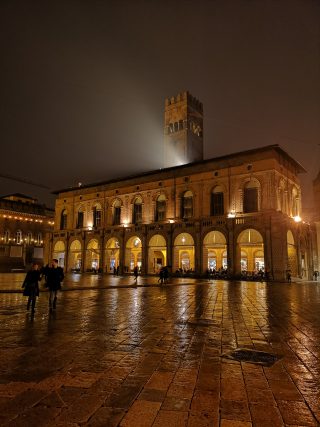
Dominating the western side of Piazza Maggiore, Palazzo d'Accursio - also known as Palazzo Comunale - is one of Bologna's most emblematic landmarks. Once the seat of civic power and government, this magnificent complex combines political history with artistic beauty, housing grand halls, exquisite frescoes, and world-class museums. For those exploring the city's medieval heart, it's one of the top attractions in Bologna and a great place to visit on a walking tour of Bologna, blending architecture, art, and history in a single remarkable space.
Today, the palace continues to serve as a cultural beacon, home to the Civic Art Collection and the Museo Morandi, which preserves the legacy of Giorgio Morandi - Bologna's most celebrated 20th-century artist. Its layered architecture and storied chambers make it an unmissable stop for anyone who wishes to understand the evolution of Bologna's civic and artistic identity.
History and Significance of Palazzo d’Accursio
Palazzo d'Accursio's origins date back to the late 13th century, when it served as the residence of Accursio, a noted jurist and professor of law at the University of Bologna. In 1336, the building became the seat of the Anziani, the city’s highest magistrates, and evolved into the heart of Bologna’s municipal government. Over the following centuries, the palace was expanded and transformed to reflect the city’s prosperity and power.
In the 15th century, architect Fioravante Fioravanti oversaw major restorations, adding one of the palace’s most recognizable features - the Clock Tower (Torre d’Accursio). Beneath its arches once stood a wooden carousel depicting the Madonna and Child with the Magi, removed in 1796 during Napoleonic reforms. The palace continued to grow and adapt through the Renaissance and Baroque eras, serving as the city’s Town Hall until November 11, 2008, when administrative functions were relocated.
Things to See and Do in Palazzo d’Accursio
The façade of Palazzo d'Accursio is a masterpiece of symbolic design, blending Gothic and Renaissance elements. Look for the terracotta Madonna and Child by Niccolò dell'Arca set above the main entrance - a delicate expression of faith and craftsmanship. Above the portal stands a striking bronze statue of Pope Gregory XIII, Bologna's native son and the reformer of the Gregorian calendar, installed in 1580. Another bronze, depicting Pope Boniface VIII, once adorned the building but now resides in the city's Medieval Museum.
Inside, the palace unfolds as a series of grand halls. On the first floor lies the Hall of the Communal Council, where the city’s senators once gathered beneath ceilings frescoed by Angelo Michele Colonna and Gioacchino Pizzoli between 1675 and 1677. The second floor holds the Farnese Hall (Sala Farnese), rebuilt in 1665 under Cardinal Girolamo Farnese and richly decorated by students of Francesco Albani. On the upper floor, visitors can explore the Municipal Art Collections (Collezioni Comunali d’Arte), featuring paintings, sculptures, and decorative arts from the Middle Ages to the 19th century - all owned by the municipality.
Palazzo d'Accursio also houses the Museo Morandi, dedicated to Giorgio Morandi's still lifes and landscapes, many of which were donated by his family. His works, celebrated for their quiet contemplation and subtle tonality, are displayed alongside drawings, etchings, and personal objects that offer a glimpse into his artistic process. From the palace's windows, visitors can enjoy a superb view over Piazza Maggiore, while part of the building's structure can also be admired from inside the nearby Biblioteca Salaborsa.
How to Get There
For those arriving by train, Bologna Centrale is the nearest major railway station and about a 15-20-minute walk or short bus ride to Piazza Maggiore. Use Omnio to easily compare schedules, book train tickets, and find the best prices all in one place for a hassle-free journey across Italy. Travelers arriving by car can park at Parcheggio VIII Agosto or Tanari Parking, both within walking distance of the palace. If you are looking to rent a car in Italy I recommend having a look at Discover Cars, first, as they compare prices and review multiple car rental agencies for you.
Practical Tips on Visiting Palazzo d’Accursio
- Best time to visit Palazzo d’Accursio: Morning or early afternoon to explore the museums and halls before crowds gather.
- Entrance fee in Euros: Free access to the ground floor; €6-8 for museum entry.
- Opening hours: Typically Tuesday to Sunday, 10 am to 6:30 pm; closed Mondays.
- Official website: www.museibologna.it
- How long to spend: 1-2 hours to explore the palace and museums fully.
- Accessibility: Elevator access available to museum levels.
- Facilities: Restrooms, cloakroom, and museum shop on-site.
- Photography tip: Capture the façade's terracotta sculptures and the view of Piazza Maggiore from the upper windows.
- Guided tours: Offered by Bologna Welcome and during cultural heritage days.
- Nearby food options: Cafés and trattorias line Piazza Maggiore and Via Clavature.
Is Palazzo d’Accursio Worth Visiting?
Absolutely. Palazzo d'Accursio is one of the must-see places in Bologna, offering a rare combination of political history, architectural beauty, and artistic treasure. From the frescoed Farnese Hall to the intimate still lifes of Giorgio Morandi, each corner of the palace reveals a different facet of the city's character - scholarly, civic, and creative. It's a space where Bologna's past and present coexist in perfect harmony.
What Other Travellers Say...

Palazzo d'Accursio on Piazza Maggiore is Bologna's historic town hall complex housing an art museum and fresco-filled chapel, with a combined ticket that often includes climbing the clock tower; visitors praise the engaging galleries of local and Romanesque Catholic art, standout frescoes and period furniture, and warn that the tower's stairs can be narrow, low in places and treacherous near the top (you may need to sign a waiver), while ticketing can be confusing if booked through some online vendors—plan a few hours to take in the exhibitions and the panoramic views over the city.


FAQs for Visiting Palazzo d’Accursio
Nearby Attractions to Palazzo d’Accursio
- Biblioteca Salaborsa - A modern library built over Roman ruins, next to the palace.
- Piazza Maggiore - Bologna's iconic main square, surrounded by historic landmarks.
- Fountain of Neptune - Giambologna's Renaissance masterpiece adjacent to the palace.
- Basilica of San Petronio - A Gothic giant facing the square with stunning frescoes.
- Palazzo del Podestà - Home to the whispering gallery and ornate portico.
The Palazzo d'Accursio appears in our Complete Guide to Visiting Bologna!

Moira & Andy
Hey! We're Moira & Andy. From hiking the Camino to trips around Europe in Bert our campervan — we've been traveling together since retirement in 2020!
This website uses affiliate links which may earn a commission at no additional cost to you!
Planning Your Visit
From Tuesday to Friday: 09:00 - 18:30
Saturday and Sunday: 10:00 - 18:30
Monday Closed
Free entry
Nearby Attractions
- Piazza Maggiore (0.1) km
Square - Piazza Nettuno (0.1) km
Statue - Palazzo del Podesta (0.1) km
Palace - Monument to Fallen Partisans (0.1) km
Monument - Palazzo Re Enzo (0.1) km
Palace - Biblioteca Salaborsa (0.1) km
Historic Site and Library - Fontana Vecchia (0.1) km
Fountain - Basilica of San Petronio (0.1) km
Basilica - Palazzo dei Banchi (0.1) km
Palace - Museo Civico Archeologico (0.2) km
Museum