Pilotta Palace, Parma
Museum and Palace in Parma
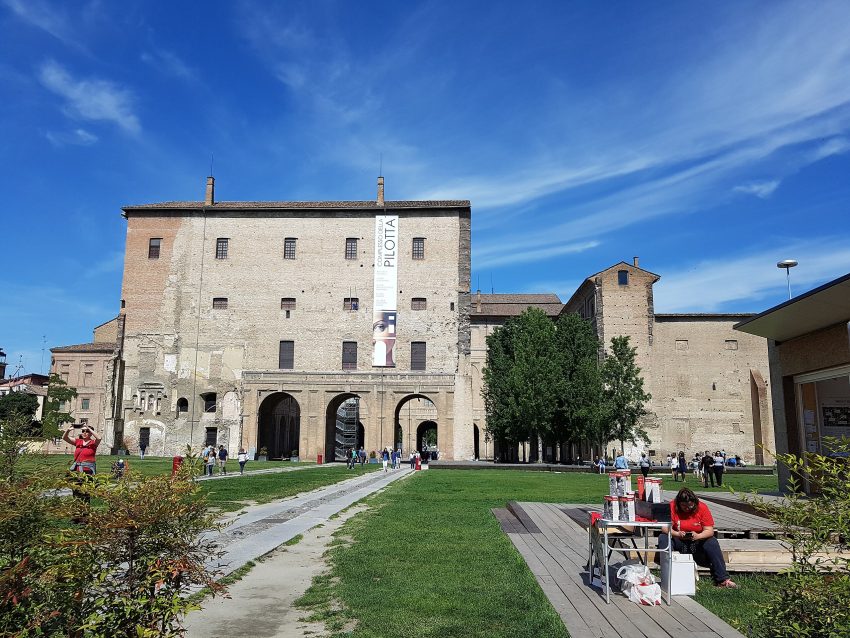
In the heart of Parma, the monumental Pilotta Palace stretches across an entire block like a stone city within the city. Originally commissioned by the powerful Farnese family, this vast complex was conceived as both a symbol of ducal authority and a practical container for court life and services. Today, its huge courtyards and austere corridors have been repurposed into one of Italy's most compelling cultural hubs, home to the National Gallery, the Archaeological Museum, the Farnese Theatre and the Palatina Library, as well as the Bodoni Museum dedicated to the art of printing. For anyone who loves art, history or architecture, Pilotta Palace is one of the best places to visit in Parma.
Walking into the complex feels like stepping backstage into the machinery of a former duchy. One moment you are in a quiet courtyard, the next you are in front of an 18th century library, a 17th century wooden theatre or galleries hung with Renaissance masterpieces. The collection ranges from Etruscan and Roman finds to works by Correggio, Parmigianino and Tintoretto, and on into modern typographic treasures from Giambattista Bodoni's presses. The palace is a highlight of any walking tour of Parma because you can easily spend half a day here and still feel that you have only scratched the surface.
Table of Contents
- History and Significance of the Pilotta Palace
- Things to See and Do in the Pilotta Palace
- How to Get to the Pilotta Palace
- Practical Tips on Visiting the Pilotta Palace
- Where to Stay close to the Pilotta Palace
- Is the Pilotta Palace Worth Visiting?
- FAQs for Visiting Pilotta Palace
- Nearby Attractions to the Pilotta Palace
History and Significance of the Pilotta Palace
Pilotta Palace was created under the Farnese dynasty, who wanted a multifunctional complex that could accommodate administrative, residential and cultural activities. Its name likely derives from the game of pelota, once played in one of its courtyards, hinting at the variety of uses the palace has seen over time. Rather than a single, symmetrical structure, it developed as a cluster of interconnected wings and large internal courts, giving it a slightly unfinished, utilitarian air that contrasts with the more polished façades of nearby palaces and churches.
As the political fortunes of the Farnese and their successors shifted, the Pilotta gradually transitioned from a ducal power centre into a cultural one. The National Archaeological Museum was founded here in 1760 by Don Philip of Bourbon, initially to house finds from the Roman town of Veleia near Piacenza. Meanwhile, the National Gallery grew under the patronage of the Dukes of Parma, accumulating paintings from the 13th to the 19th centuries and becoming a key repository for the Emilian school. The Palatina Library, installed in elegant rooms within the complex, added a literary dimension to the palace's role as a guardian of knowledge.
The Farnese Theatre, built in 1618-1619 by order of Ranuccio I Farnese and designed by G.B. Aleotti, brought spectacular court entertainments into the mix. Inspired by Palladio's Teatro Olimpico in Vicenza, it housed ingenious stage machinery capable of creating land and sea effects that dazzled audiences. Though damaged and later reconstructed after World War II, it remains one of Italy's most beautiful historical theatres. With the later addition of the Bodoni Museum, dedicated to Giambattista Bodoni's revolutionary typefaces and printing tools, Pilotta Palace consolidated its status as Parma's cultural engine: a place where visual art, archaeology, theatre, books and typography all coexist under one monumental roof.
Things to See and Do in the Pilotta Palace
Most visits start with the National Gallery, where you can trace Italian and European painting from the 13th to the 19th centuries. Spend time with works by Correggio and Parmigianino, whose paintings are central to Parma’s artistic identity, then move on to canvases by Tintoretto, Guercino and other Italian masters. Look out for a painting attributed to Leonardo da Vinci and portraits by Hans Holbein the Younger, which give the collection a broader European scope. The galleries are a superb place to appreciate the richness of the Emilian school from the 15th to the 18th centuries and to see how it interacts with other regional styles.
Next, step into the Farnese Theatre, one of the true highlights of the complex. The horseshoe-shaped stalls, carved entirely from wood, are surrounded by two tiers of loggias with Palladian windows and Doric and Ionic columns. Standing in the middle of the auditorium, you can almost feel the presence of the 17th century court, watching as spectacular productions unfolded with movable scenery, elaborate galleries and special effects that recreated both land and sea. Even in its reconstructed state, completed in 1950 after wartime damage, the theatre remains an extraordinary example of early Baroque stage architecture and engineering.
The National Archaeological Museum offers a change of pace, grounding you in ancient history. Founded in 1760 to house finds from Veleia, it now displays the famous Tabula Alimentaria of Emperor Trajan, an inscribed bronze tablet detailing provisions for the care of poor children, alongside other Roman artefacts. Take time in the Hall of Ceramics and the Egyptian Section, where objects from daily life and ritual give a tangible sense of far older cultures. Finally, visit the Bodoni Museum, where drawers of punches, matrices, alphabet boxes and presses show how Giambattista Bodoni transformed Parma’s Royal Printing Works into a world-class printing centre. Seeing the Greek Iliad printed in 1808 and other rare works, you realise that the palace does not just preserve finished artworks but the tools and processes that created them.
How to Get to the Pilotta Palace
Pilotta Palace is centrally located in Parma, a short walk from the main squares and the river, making it easy to reach once you are in the city. Parma has a small local airport and is also well served by larger airports such as Bologna and Milan, from which you can continue by regional train, coach or hire car to Parma. For the best deals and a seamless booking experience, check out these flights to Parma on Booking.com. From the arrival point in the city, local buses and taxis can drop you close to the historic centre, from where Pilotta Palace is clearly signposted.
If you are travelling by train within Italy, Parma lies on major rail lines connecting Milan, Bologna and other northern cities, so it slots easily into a wider itinerary.Use Omnio to easily compare schedules, book train tickets, and find the best prices all in one place for a hassle-free journey across Italy. From the railway station, it is roughly a 10-15 minute walk along flat streets to the palace; just follow signs towards the centre and the riverfront, and you will soon see the imposing bulk of the complex. City buses also run from the station area to stops near the palace if you prefer not to walk.
Arriving by car, use the A1 motorway or other regional routes to reach Parma, then follow signs for the centro storico and park in one of the central car parks on the edge of the historic zone.If you are looking to rent a car in Italy I recommend having a look at Discover Cars, first, as they compare prices and review multiple car rental agencies for you. From your parking spot, it is a short stroll through city streets to the palace complex, which you can recognise by its extensive arcades, internal courtyards and proximity to the river.
Practical Tips on Visiting the Pilotta Palace
- Suggested tips: Plan at least half a day if you want to experience the National Gallery, Archaeological Museum, Farnese Theatre and Bodoni Museum without rushing; pick two or three priorities if your time is short.
- Best time to visit: Late morning or early afternoon on weekdays is usually quieter; weekends and special exhibition days can be busier, especially in peak season.
- Entrance fee: € 16.00
- Opening hours: Open from Tuesday to Sunday from 10.30am to 7pm (last entrance at 6pm).
- Official website: http://www.complessopilotta.it/
- How long to spend: Allow 3-4 hours for a comprehensive visit to the main museums and the theatre; serious art or history enthusiasts may want to devote most of a day.
- Accessibility: The complex is large and historic, but many areas have been adapted with lifts and ramps; check specific access details for each museum if you have mobility needs and be prepared for some walking.
- Facilities: Expect ticket offices, information desks, toilets and possibly a café or vending area within or near the complex; numerous cafés and restaurants lie just outside in the city centre.
- Photography tip: In the courtyard, use wide angles to capture the scale of the palace; inside, focus on the wooden interior of the Farnese Theatre and highlight key artworks in the National Gallery, respecting any no-flash or no-photo zones.
- Guided tours: Look for guided tours that include the Farnese Theatre and selected museum sections; a guide can help you navigate the sheer volume of material and explain highlights in context.
- Nearby food options: After your visit, head towards nearby streets and squares for classic Parma dishes, from cured meats and Parmesan cheese tastings to fresh pasta in local trattorias.
Where to Stay close to the Pilotta Palace
Staying in Parma's historic centre gives you easy access to Pilotta Palace and the rest of the city's main sights. A refined option within walking distance of both the palace and key squares is Grand Hotel de la Ville Parma, which offers modern comfort and a pleasant stroll into the old town. For a more historic setting closer to the cathedral and baptistery yet still convenient for Pilotta Palace, Palazzo Dalla Rosa Prati places you directly on Piazza Duomo with easy walking access to the complex. Another central, characterful choice is Hotel Button, a friendly base that puts you within a short walk of Pilotta Palace, Piazza Garibaldi and many of Parma's best cafés and restaurants.
Is the Pilotta Palace Worth Visiting?
Pilotta Palace is unquestionably worth visiting, especially if you are drawn to art, archaeology or theatre. Few places in Italy offer such a concentrated mix of cultural experiences under one roof: you can move from a 17th century wooden theatre to a gallery of Renaissance masterpieces, from Roman artefacts and Trajan's Tabula Alimentaria to the tools that changed the history of printing. The building's monumental scale and slightly rough, unfinished character contrast beautifully with the treasures it holds, making each transition between spaces feel like a discovery. For many travellers, a day at Pilotta Palace becomes the intellectual and artistic high point of their time in Parma.
What Other Travellers Say...

Palazzo della Pilotta, on Piazza della Pilotta in Parma, is a vast 16th-century palace complex that now houses the National Gallery, the Farnese Theatre and several museums; visitors praise its grand architecture, expansive courtyards and richly varied art collections—from paintings and sculptures in the Galleria Nazionale to the dramatic wooden Teatro Farnese, the Archaeological Museum, the Palatina Library and a Bodoni museum—recommending planning several hours to explore the many rooms and saying the site feels like a concentrated cultural world that tells Parma's artistic story.


FAQs for Visiting Pilotta Palace
Nearby Attractions to the Pilotta Palace
- Cattedrale di Parma: Romanesque cathedral with Correggio's Assumption of the Virgin in the dome, located a short walk away on Piazza Duomo.
- Baptistery of Parma: Pink Verona marble baptistery beside the cathedral, rich in medieval sculpture and symbolic decoration.
- Piazza Garibaldi: Central civic square framed by historic palaces, shops and cafés, ideal for a break between cultural visits.
- Teatro Regio di Parma: Neoclassical opera house renowned for its Verdi productions and elegant white-and-gold auditorium.
- Parco Ducale: Formal park across the river, offering tree-lined avenues, statues and a calm green space after a museum-filled day.
The Pilotta Palace appears in our Complete Guide to Visiting Parma!

Moira & Andy
Hey! We're Moira & Andy. From hiking the Camino to trips around Europe in Bert our campervan — we've been traveling together since retirement in 2020!
This website uses affiliate links which may earn a commission at no additional cost to you!
Planning Your Visit
Open from Tuesday to Sunday from 10.30am to 7pm (last entrance at 6pm).
€ 16.00
Nearby Attractions
- Teatro Farnese (0.0) km
Historic Building and Theatre - Regio Theatre (0.2) km
Historic Building and Theatre - Chamber of St. Paul and Cell of St. Catherine (0.2) km
Monastery - Basilica Santa Maria della Steccata (0.3) km
Basilica - Diocesan Museum (0.3) km
Museum - Baptistery of Parma (0.4) km
Baptistery - Piazza Garibaldi (0.4) km
Square - Cattedrale di Parma (0.4) km
Cathedral - Monastic Complex of San Giovanni Evangelista (0.5) km
Monastery - Parco Ducale (0.5) km
Park