Koh Ker Pyramid Temple, Siem Reap
Buddhist Temple near Siem Reap
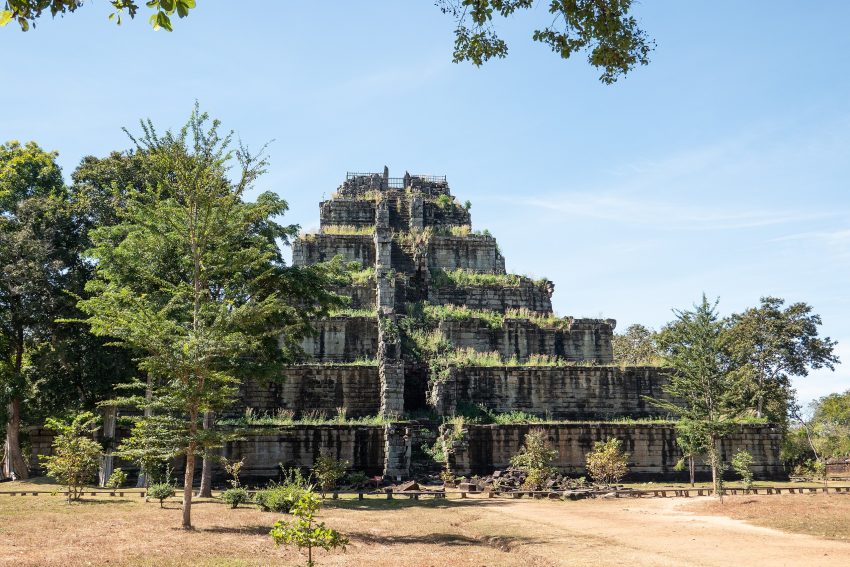
Many of the sandstone towers in and around Prasat Thom at Koh Ker are remarkable for their massive size, rivaled only by Phnom Bok in Angkor, which housed some of the largest Lingas in Cambodia. French archaeologist Lunet de Lajonquière suggested that the limitations of Khmer construction techniques necessitated an increased reliance on wooden carpentry in Koh Ker's architectural designs.
A defining feature of Koh Ker’s architecture and sculpture is the use of enormous sandstone blocks, made readily accessible by the area’s abundant natural supply. This ease of access significantly reduced the challenges of transporting materials compared to Angkor. Although brick remained the predominant construction material, the use of sandstone and laterite increased notably. Square ground plans were most common, but rectangular buildings, once primarily limited to galleries, began to be used for libraries and other structures, reflecting a shift in design preferences.
Koh Ker’s principal temple, Prasat Thom, showcases advancements in gallery architecture, with almost continuous gallery buildings in its second enclosure and the semi-open column hall at its outer gate. However, the arrangement of towers in a quincunx, popular in earlier periods such as at Bakheng, is less prevalent, though it appears at Prasat Krachap. Notably, all Koh Ker monuments are dedicated to Hindu deities, predominantly Shiva, with no shrines for the Buddha. This absence contrasts with earlier and later Khmer periods when the Buddha was venerated alongside Shiva and Vishnu, despite being considered unorthodox in his Indian origin.
Table of Contents
History of Koh Ker
Koh Ker, once known as Chok Gargyar, served as the capital of the Khmer Empire for about two decades in the second quarter of the 10th century, replacing Angkor. This short but significant period saw the construction of most of the site’s monuments, making Koh Ker the second-largest temple complex in Cambodia, surpassed only by Angkor itself. The rise of Koh Ker as the empire’s capital was closely tied to the reign of Jayavarman IV, who ascended to the throne after a contested succession, marking a pivotal shift in the political and religious landscape of the Khmer Empire.
Jayavarman IV’s decision to establish Koh Ker as the new capital was likely influenced by the region’s resources and strategic location. Situated near hills rich in valuable minerals like iron, copper, and gold, as well as along important trade routes, Koh Ker offered both economic and military advantages. During his reign, Jayavarman IV initiated an ambitious building program that included the construction of a massive step pyramid and other monumental temples, all dedicated to Hindu deities, particularly Shiva. The largest Shiva Linga, placed atop the tallest temple pyramid, symbolized his claim to supreme power, while inscriptions from the period boast of surpassing the grandeur of previous kings.
The capital remained at Koh Ker until Jayavarman IV’s successor, Harshavarman II, moved the capital back to Angkor in the early 10th century. Despite this, the architectural and cultural legacy of Koh Ker endured, influencing regions beyond Cambodia, including northeastern Thailand. The site’s history was later rediscovered by French explorers and scholars, beginning in the 19th century, who uncovered its monumental temples and distinctive style. Today, Koh Ker remains an important archaeological and cultural landmark, with ongoing efforts to explore and preserve its vast temple complex, which covers an area of over 80 square kilometers.
Temple Groups of Koh Ker
The temples of Koh Ker can be categorized into three distinct groups:
- The ruins of the fortified capital, including the main complex of Prasat Thom and the pyramid of Prasat Prang to the north of the Rahal reservoir.
- A row of temples situated to the north and east of the Rahal Baray, all aligned along the eastern section of the ring road encircling the city reservoir.
- Smaller temples located to the south of the Rahal, mostly oriented eastward, many of which are enclosed by walls.
Important Temples
Prasat Damrei and the nearby large temples are typically included in the northern group, though some guidebooks and websites categorize them as part of the southern temples.
Prasat Thom is the largest temple compound in Koh Ker. In its narrower sense, Prasat Thom is just a part of the entire imperial temple complex, which includes concentric structures with three enclosing walls and a wide moat. To the east lies the gate known as Prasat Krahom, along with the so-called palaces. To the west of the core temple is the step pyramid, a prominent landmark of Koh Ker, and the artificial mound known as the Tomb of the White Elephant.
Prasat Balang, located at the northern end of the northern temple group, serves as a prime example of the five similar Linga shrines in the area. The Lingams housed within these temples are notably large and impressive.
Prasat Krachap is one of the four major complexes in the northern group. It is particularly notable for its well-preserved inscriptions, including those found at the western entrance gate, which provide valuable insights into the site’s history.
Prasat Banteay Pirchan (Banteay Pee Chean) is the only temple complex at Koh Ker dedicated to Brahma, a central figure in the Hindu Trimurti. This temple is one of the most picturesque and visually striking ruins in the region.
Prasat Chrap features a typical row of three temples, a common architectural arrangement seen throughout the site.
Prasat Damrei is renowned for its captivating elephant and lion sculptures, which contribute to its unique charm and artistic value.
Prasat Neang Khmau, constructed from laterite, is notable for its distinctive bluish and darkened appearance due to oxidation of the stone over time.
Prasat Chen (Chin) earned its nickname “Chinese Temple” due to the remarkable statues found here, which feature hair queues. Koh Ker's famous “fighting monkeys” are now displayed at the National Museum in Phnom Penh.
Prasat Pram (Bram) is often referred to as the “fairy tale” temple of Koh Ker. The roots that envelop the northwest Prasat create a picturesque scene, reminiscent of a temple hidden deep within the jungle, making it a favorite among visitors and photographers.
What Other Travellers Say...

Koh Ker Pyramid Temple, located in northern Cambodia, is the ruined heart of an ancient complex whose centerpiece is a seven-tiered pyramid (Prasat Thom) rising above the jungle; visitors describe a peaceful, photogenic site where you can climb numbered, well-spaced steps to panoramic views over forest canopy, encounter shrines with surviving carvings and stone lingas, and feel the atmosphere of a rediscovered city largely reclaimed by nature—an off-the-beaten-path alternative to busier temples that rewards those seeking a quieter, adventurous visit.


The Koh Ker Pyramid Temple appears in our Complete Guide to Visiting Siem Reap!

Moira & Andy
Hey! We're Moira & Andy. From hiking the Camino to trips around Europe in Bert our campervan — we've been traveling together since retirement in 2020!
This website uses affiliate links which may earn a commission at no additional cost to you!
Nearby Attractions
- Prasat Preah Vihear (69.2) km
Buddhist Temple - Phnom Bok (69.5) km
Buddhist Temple - Ta Som (76.2) km
Buddhist Temple - East Mebon Temple (76.5) km
Buddhist Temple - Pre Rup Temple (77.1) km
Buddhist Temple - Pre Rup Temple (77.1) km
Hindu Temple - Krol Ko Temple (77.7) km
Buddhist Temple - Neak Pean (78.0) km
Buddhist Temple - Neak Poan – The Mystical Island Temple (78.0) km
Buddhist Temple - Bakong Temple (78.6) km
Buddhist Temple