Kesik Minaret, Antalya
Minaret in Antalya

Kesik Minaret, or “Broken Minaret,” is one of the most evocative landmarks in Antalya's Old Town. Set among the narrow cobbled streets of Kaleiçi, this historic site tells the story of the city through its changing architecture and purpose over two thousand years. What began as a Roman temple evolved into a Byzantine church, later converted into a mosque, and eventually left in partial ruin after a devastating fire. The result is a structure that beautifully captures the layers of Antalya's history in one quiet corner of the old city.
History and Significance
The story of Kesik Minaret begins in the 2nd century AD, when the Romans built a temple dedicated to their gods. During the Byzantine era, the site was transformed into a Christian church, complete with mosaics and marble columns. When the Seljuks arrived in the 13th century, it was converted into a mosque, and a minaret was added to the complex. This tower stood proudly over the Old Town until the 19th century, when a fire destroyed much of the structure, leaving only its base and partial walls standing.
The ruins that remain today are hauntingly beautiful. Arched doorways, sections of stone walls, and fragments of columns stand open to the sky, a visible record of Antalya’s multicultural past. The name “Kesik,” meaning “cut” or “broken,” refers to the minaret’s missing top section, which has become a poetic symbol of the city’s endurance and transformation over the centuries.
Recent restoration work has stabilized the ruins, allowing visitors to get closer and appreciate the craftsmanship of the ancient stonework. The site’s simplicity and openness create an atmosphere that invites quiet reflection - a moment to pause in the middle of Antalya’s lively streets.
Things to See and Do
Visitors to Kesik Minaret can walk around the perimeter of the ruins, exploring the old stonework and the surviving sections of the mosque and church. Informational plaques explain the site's long history, and from several angles, you can capture dramatic photographs of the archways and remains against the backdrop of Kaleiçi's red-tiled roofs.
For a deeper appreciation, take time to imagine the transformations this place has witnessed - from Roman rituals to Byzantine hymns and Islamic prayers. The combination of cultural layers makes Kesik Minaret one of the best places to see in Antalya, particularly for travellers interested in archaeology and religious history.
Because it's located in the heart of Kaleiçi, the site is easy to include as part of a walking tour. You'll find charming cafés and small shops nearby, making it a pleasant stop between exploring Hadrian's Gate and the Old City Marina. The quiet setting and absence of crowds make it a great place to visit on a walking tour of Antalya, especially in the early morning when the streets are still calm.
Practical Information
- Best time to visit: Early morning or late afternoon for the best light and fewer visitors.
- Entrance fee: Free.
- Opening hours: Open during daylight hours.
- Official website: Not applicable.
- How long to spend: 20-30 minutes.
- Accessibility: Some uneven stone surfaces; accessible by foot from Kaleiçi’s main streets.
- Photography tip: Frame the remaining arch and stone walls against the surrounding houses for striking contrast.
- Nearby food options: Numerous cafés and traditional restaurants in Kaleiçi within a five-minute walk.
Is Kesik Minaret Worth Visiting?
Yes - Kesik Minaret is absolutely worth visiting for anyone interested in history, architecture, or the quiet charm of Kaleiçi. While not as grand as other ancient sites, its significance lies in its story: a single site that has been shaped by so many cultures and faiths. The sense of continuity and resilience it represents is what makes it memorable.
It's also one of the most photogenic stops in the Old Town, especially at sunset when the golden light hits the ancient stones. Whether you're exploring Kaleiçi for a few hours or spending the whole day there, Kesik Minaret adds depth and perspective to your understanding of Antalya's layered past.
Nearby Attractions
Nearby the Kesik Minaret, visitors will find several of Antalya's most captivating landmarks within easy walking distance. Just a few minutes away stands Hadrian's Gate, the grand Roman triumphal arch that once marked the entrance to the ancient city and now serves as one of the most popular photo spots in Kaleiçi. From there, a short stroll leads to the Tekeli Mehmet Paşa Mosque, a fine example of Ottoman religious architecture, known for its peaceful interior and delicate tile work.
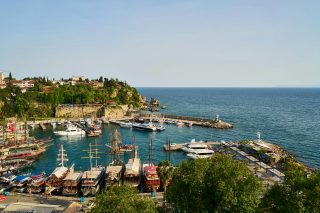
If you continue toward the coast, you'll reach the Old City Marina, a picturesque harbour where fishing boats and yachts float below the city walls. It's the perfect place to pause for a coffee or seafood lunch while watching the sun shimmer on the water. A little further north lies the Yivli Minaret Mosque, Antalya's most famous landmark and an enduring symbol of the city, visible from nearly every point in the Old Town.
For a quieter experience, Karaalioglu Park is just a short walk to the south. This clifftop park offers some of the best panoramic views in Antalya, especially at sunset when the Mediterranean glows gold beneath the sky. Together, these nearby attractions make the Kesik Minaret an easy and rewarding stop on any exploration of Kaleiçi, tying together the city's Roman, Ottoman, and modern heritage in one compact area.
What Other Travellers Say...

Yivliminare Mosque in Selçuk sits in Antalya's old town and is best known for its 13th-century fluted red‑brick minaret rising about 38 m above the skyline; visitors praise the striking ribbed design, turquoise tiles, domes and peaceful courtyard, note the complex includes historic tombs and a small ethnographic museum, and warn the mosque is often closed so you may only be able to admire the exterior—visit early or late for the best light.


The Kesik Minaret appears in our Complete Guide to Visiting Antalya!

Moira & Andy
Hey! We're Moira & Andy. From hiking the Camino to trips around Europe in Bert our campervan — we've been traveling together since retirement in 2020!
This website uses affiliate links which may earn a commission at no additional cost to you!
Planning Your Visit
Nearby Attractions
- Suna & İnan Kıraç Kaleiçi Museum (0.2) km
Museum - Hıdırlık Tower (0.3) km
Roman Site - Mermerli Beach (0.3) km
Beach - Atatürk House and Museum (0.3) km
Historic Building and Museum - İskele Mosque (0.3) km
Park - Old City Marina (0.3) km
Marina - Karaalioglu Park (0.3) km
Park - Hadrian's Gate (0.4) km
City Gate - Tekeli Mehmet Paşa Mosque (0.4) km
Mosque - Yivli Minaret (0.5) km
Minaret