Independence Monument, Phnom Penh
Monument in Phnom Penh
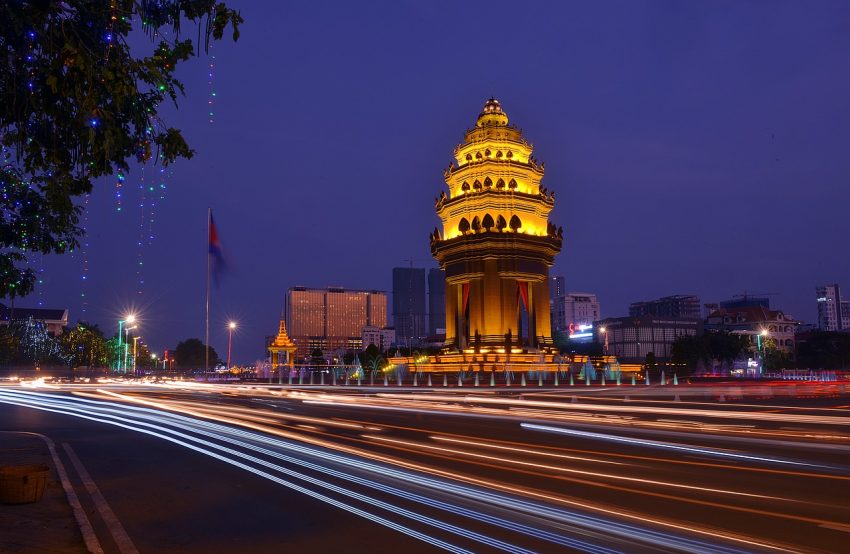
Rising from the busy junction of Norodom and Sihanouk Boulevards, the Independence Monument is one of the top attractions in Phnom Penh, a 37-metre lotus-shaped tower that symbolises Cambodia's hard-won freedom from French colonial rule in 1953. Completed in 1958 and inspired by the elegant forms of Khmer temples such as Banteay Srei, it blends sacred symbolism with civic pride, standing at the heart of a broad traffic circle and park that locals use for everything from jogging and picnics to national ceremonies.
Designed by renowned architect Vann Molyvann under the guidance of Prince Norodom Sihanouk, the monument's many tiers and naga-lined cornices echo ancient stupas while clearly belonging to the modern city around them. At night, dramatic lighting emphasises the sculpted details and flags ripple along the surrounding avenues, making this a highlight of any walking tour of Phnom Penh, especially if you combine it with the nearby Norodom Sihanouk Memorial and riverside promenade.
Table of Contents
- History and Significance of the Independence Monument
- Things to See and Do in the Independence Monument
- How to Get to the Independence Monument
- Practical Tips on Visiting the Independence Monument
- Where to Stay close to the Independence Monument
- Is the Independence Monument Worth Visiting
- FAQs for Visiting Independence Monument Phnom Penh
- Nearby Attractions to the Independence Monument Phnom Penh
History and Significance of the Independence Monument
The Independence Monument was commissioned to commemorate Cambodia's independence from France in 1953 and to give Phnom Penh a focal point worthy of its status as a modern capital. Completed in 1958, it stands at the intersection of Norodom and Sihanouk Boulevards, a deliberately prominent roundabout chosen so that the structure would be visible from many angles in the city centre. Its presence marks a shift from colonial avenues to a streetscape defined by Khmer-inspired landmarks.
Architect Vann Molyvann, often described as the father of New Khmer Architecture, drew heavily on classical motifs for the design. The monument takes the form of a lotus-shaped stupa, its profiles and carvings reminiscent of temples like Banteay Srei, with multiple tiers and stylised naga balustrades. By placing a temple-like structure in the middle of a secular civic space, Molyvann and Prince Norodom Sihanouk created a monument that bridges religious and political symbolism: a reminder that independence was both a national and spiritual rebirth.
Beyond its aesthetics, the monument functions as a living memorial. It anchors the broad ceremonial axis of the city and provides a venue for wreath-laying, parades and national events. The nearby Norodom Sihanouk Memorial, added in 2013, extends this narrative into the late 20th and early 21st centuries, honouring the king whose life was entwined with independence, war, exile and eventual national reconciliation. Together, the two monuments tell a story of struggle, loss and resilience that is central to Cambodia’s modern identity.
Things to See and Do in the Independence Monument
Most visitors first experience the Independence Monument from a distance, admiring how it rises above the traffic with its layered, lotus-like crown. As you approach on foot, you can appreciate the details: the rhythmic repetition of tiers, the naga heads projecting from corners and the precise symmetry that makes the structure feel both dynamic and balanced. Walk the perimeter of the roundabout park to view the monument from different angles and notice how it lines up with the long perspectives of Norodom and Sihanouk Boulevards.
At the base, the monument’s pedestal houses a ceremonial flame that is lit on important national occasions, often by a member of the royal family or a senior official. On these days, the steps are dressed with flowers and wreaths, and the surrounding area fills with soldiers, dignitaries and onlookers. Even on ordinary days, you may see people using the nearby park for exercise, couples taking photos or families pausing on benches in the shade, all of which underline how this remains a lived civic space rather than a distant, fenced-off landmark.
Do not miss the Norodom Sihanouk Memorial close by. This elegant pavilion and statue pay tribute to the former king and head of state, whose role in securing independence and steering the country through turbulent decades is deeply woven into modern Cambodian history. Combined with an evening stroll along the nearby boulevards and down towards the riverfront, a visit to the Independence Monument area gives you a rounded sense of Phnom Penh's monumental heart. This spot is one of the best places to see in Independence Monument's surrounding district if you want strong visuals and powerful symbolism in a single stop.
How to Get to the Independence Monument
For most travellers, the nearest major gateway is Phnom Penh International Airport, with frequent regional flights and straightforward connections into the city by taxi, tuk-tuk or ride-hailing services. For the best deals and a seamless booking experience, check out these flights to Phnom Penh on Booking.com.
You can also reach Phnom Penh by train from Sihanoukville or Poipet, or more commonly by bus and minivan services from cities such as Siem Reap, Battambang or Kampot.Train schedules and bookings can be found on Omio. Once in the capital, tuk-tuks and taxis provide the simplest way to get to the Independence Monument from popular areas like the riverside, BKK1 or Central Market.
If you are travelling by car, the monument sits in the centre of a major roundabout at the junction of Norodom and Sihanouk Boulevards, and most visitors ask their driver to drop them at one of the pedestrian-accessible points around the circle before walking into the surrounding park.
Practical Tips on Visiting the Independence Monument
- Suggested tips: Combine a visit to the Independence Monument with nearby landmarks such as the Norodom Sihanouk Memorial and a walk along Norodom Boulevard, timing your visit for late afternoon or early evening when the heat eases and lights come on.
- Best time to visit: Early morning brings cooler air and local joggers in the surrounding park, while sunset and early evening offer dramatic lighting and a pleasant atmosphere around the boulevards.
- Entrance fee: There is no fee to view the monument and surrounding park
- Opening hours: The monument and park can be viewed at any time from the surrounding pavements.
- How long to spend: Plan 20-40 minutes to walk the perimeter, take photos from different angles, and visit the Norodom Sihanouk Memorial; longer if you combine it with a broader stroll towards the riverfront.
- Accessibility: The area around the roundabout is mostly level, but crossing busy roads requires care; visitors with mobility issues may prefer to approach from the side with wider pavements and controlled crossings.
- Facilities: There are no major facilities directly at the monument, but cafés, convenience stores and restaurants can be found on nearby streets, along with ATMs and small shops.
- Photography tip: Shoot from across the boulevard to capture the full height and lotus profile, then return at night if possible to photograph the illuminated monument against the dark sky and passing traffic trails.
- Guided tours: Many half-day or full-day Phnom Penh tours include a brief stop at the Independence Monument, where guides can explain its symbolism, history and role in national ceremonies.
- Nearby food options: The surrounding neighbourhood and nearby BKK1 district offer plenty of cafés and eateries, making it easy to pair your visit with breakfast, a coffee stop or an evening meal.
Where to Stay close to the Independence Monument
Staying near the Independence Monument puts you between the riverside and the popular BKK1 district, with easy access to many of Phnom Penh's key sights. A comfortable, modern option on one of the city's main avenues is Anik Palace Hotel, which offers a smart base within a short ride or even a walk of the monument. For a stylish urban-resort feel with a rooftop pool and views towards the city centre, Aquarius Hotel and Urban Resort is a convenient choice that keeps you close to both the monument and the Royal Palace area. Travellers who prefer a boutique atmosphere might opt for Pasteur 51 Hotel and Residences, well placed for exploring the Independence Monument, BKK1 restaurants and the wider downtown on foot or by tuk-tuk.
Is the Independence Monument Worth Visiting
The Independence Monument is well worth adding to your Phnom Penh itinerary, especially if you are interested in how architecture reflects national identity. In a relatively short stop you can see how ancient Khmer forms have been reimagined for a modern capital, how Cambodia commemorates its independence and how public space is used for both ceremony and everyday life. Viewed alongside the Norodom Sihanouk Memorial and the surrounding boulevards, it offers a concise, powerful snapshot of the country's 20th century journey from colonial rule to sovereignty, making it a highlight of any walking tour of Phnom Penh.
What Other Travellers Say...

Independence Monument on Norodom Blvd is a 20‑m landmark built to celebrate Cambodia's independence, standing in the middle of a busy roundabout and shaped like a lotus with gardens and open spaces around it; visitors say it's an impressive photo spot best visited late afternoon or evening when lights come on, the nearby park offers a pleasant place to walk or relax, the area is kept clean and feels secure, but beware heavy traffic when crossing to the monument and don't expect much beyond sightseeing.


FAQs for Visiting Independence Monument Phnom Penh
Nearby Attractions to the Independence Monument Phnom Penh
- Norodom Sihanouk Memorial: A nearby pavilion and statue honouring the former king, closely linked to Cambodia’s independence and later history.
- Wat Langka: A historic pagoda within walking distance, offering insight into Phnom Penh's Buddhist life and a calmer contrast to the busy roundabout.
- Riverside promenade and Sisowath Quay: A short tuk-tuk ride away, this riverfront strip is ideal for sunset walks, cafés and people watching.
- Royal Palace and Silver Pagoda: The ceremonial and spiritual heart of Cambodia's monarchy, easily combined with a visit to the monument in a single day.
- Tuol Sleng Genocide Museum: A sobering former prison turned memorial, providing essential context on Cambodia's more recent struggles and resilience.
The Independence Monument appears in our Complete Guide to Visiting Phnom Penh!

Moira & Andy
Hey! We're Moira & Andy. From hiking the Camino to trips around Europe in Bert our campervan — we've been traveling together since retirement in 2020!
This website uses affiliate links which may earn a commission at no additional cost to you!
Planning Your Visit
The monument and park can be viewed at any time from the surrounding pavements.
There is no fee to view the monument and surrounding park
Nearby Attractions
- Wat Langka (0.1) km
Buddhist Temple - Royal Palace of Cambodia (0.9) km
Palace - National Museum of Cambodia (1.1) km
Museum - Wat Ounalom (1.3) km
Buddhist Temple - Tuol Sleng Genocide Museum (1.4) km
Museum - Central Market (Phsar Thmey) (1.7) km
Market - Sisowath Quay (1.8) km
Walk - Phnom Penh Night Market (2.0) km
Market - Wat Phnom (2.3) km
Buddhist Temple - Russian Market (Phsar Toul Tum Poung) (2.3) km
Market