Hadrian's Gate, Antalya
City Gate in Antalya

Hadrian's Gate, or Üçkapılar (Three Gates), is one of the top attractions in Antalya and a magnificent reminder of the city's Roman past. Built in 130 AD to commemorate Emperor Hadrian's visit, this triumphal arch marks the grand entrance to the Old Town (Kaleiçi). With its striking white marble, elegant columns, and intricate carvings, it is easy to see why this is one of the best places to see in Antalya. Visitors today can walk through the same arches that once welcomed ancient rulers and traders, connecting centuries of history in a single stroll.
History and Significance
Constructed in honour of Emperor Hadrian, the gate has stood for nearly two millennia as one of Pamphylia’s finest examples of Roman architecture. According to legend, the Queen of Sheba herself is said to have passed under these arches on her journey to visit King Solomon. The structure features three graceful arches supported by Corinthian columns and crowned with decorative reliefs. Its preservation is remarkable, partly because it remained enclosed within city walls for centuries and was only rediscovered when the walls collapsed.
The two towers flanking the gate were added in different eras, further illustrating Antalya's layered history. The southern tower, Julia Sancta, dates from Hadrian's time, while the northern tower combines ancient foundations with a Seljuk-era upper section. Together, they frame the arch beautifully, creating one of the city's most photogenic scenes and a highlight of any walking tour of Antalya.
Things to See and Do
- Walk through the three arches and imagine the grandeur of the Roman Empire as you enter Kaleiçi.
- Observe the intricate marble carvings and Corinthian columns that showcase Roman craftsmanship.
- Visit after sunset when the gate is beautifully illuminated, casting dramatic shadows across the stones.
- Take time to explore both towers, which reveal different architectural periods of Antalya’s past.
- Capture photos from both sides of the gate - one facing the modern city and the other leading into the Old Town.
Practical Tips for Visitors
- Best time to visit: Early morning for fewer crowds or evening when the monument is lit up.
- How long to spend: 20 to 40 minutes to explore and photograph the site.
- Photography tip: Stand slightly off-centre to capture all three arches and the framing towers.
- Accessibility: The gate is located at ground level and accessible to most visitors.
- Nearby food options: Several cafés and restaurants nearby offer traditional Turkish dishes and coffee.
How to Get There
Hadrian's Gate is located at the entrance to Kaleiçi, Antalya's Old Town, on Atatürk Boulevard. It is easily reached on foot from nearby landmarks such as Republic Square or the Clock Tower. The nearest tram stop is İsmetpaşa on the AntRay line, which connects to other parts of the city. Local buses and taxis also stop nearby, and the surrounding area is pedestrian-friendly.
Nearby Attractions
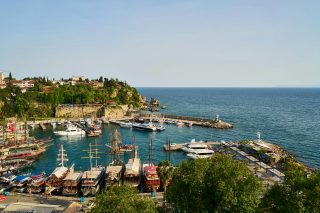
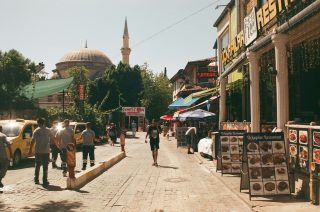
Hadrian's Gate sits in the heart of Antalya's historic district, making it the perfect starting point for exploration. Just beyond the gate lies Kaleiçi, a maze of cobblestone streets lined with Ottoman-era houses, shops, and boutique hotels. A short walk away are the Tekeli Mehmet Paşa Mosque and the Yivli Minaret Mosque, both rich in architectural beauty. The Old City Marina, with its scenic sea views and seafood restaurants, is also close by. Together, these sites make Hadrian's Gate one of the must-see places in Antalya, blending ancient history with the vibrant life of the modern city.
What Other Travellers Say...

Hadrian's Gate in Antalya stands at the entrance to Kaleiçi on Atatürk Caddesi and is a well-preserved Roman triumphal arch with three arches, ornate columns and carved details; visitors praise its intact marble and original stone pavement, note the deep wheel grooves, and say it serves as an impressive, free and open gateway into the old town where narrow streets, shops, cafés and eateries await.


The Hadrian's Gate appears in our Complete Guide to Visiting Antalya!

Moira & Andy
Hey! We're Moira & Andy. From hiking the Camino to trips around Europe in Bert our campervan — we've been traveling together since retirement in 2020!
This website uses affiliate links which may earn a commission at no additional cost to you!
Planning Your Visit
24 hours
Free
Nearby Attractions
- Suna & İnan Kıraç Kaleiçi Museum (0.2) km
Museum - Tekeli Mehmet Paşa Mosque (0.3) km
Mosque - Saat Kulesi (Clock Tower) (0.3) km
Tower - Attalos II Monument (0.4) km
Monument - Kesik Minaret (0.4) km
Minaret - Yivli Minaret (0.4) km
Minaret - İskele Mosque (0.5) km
Park - Old City Marina (0.5) km
Marina - Atatürk House and Museum (0.5) km
Historic Building and Museum - Atatürk Monument and Republic Square (0.5) km
Monument and Square