Grottes de Betharram, Lourdes
Cave near Lourdes
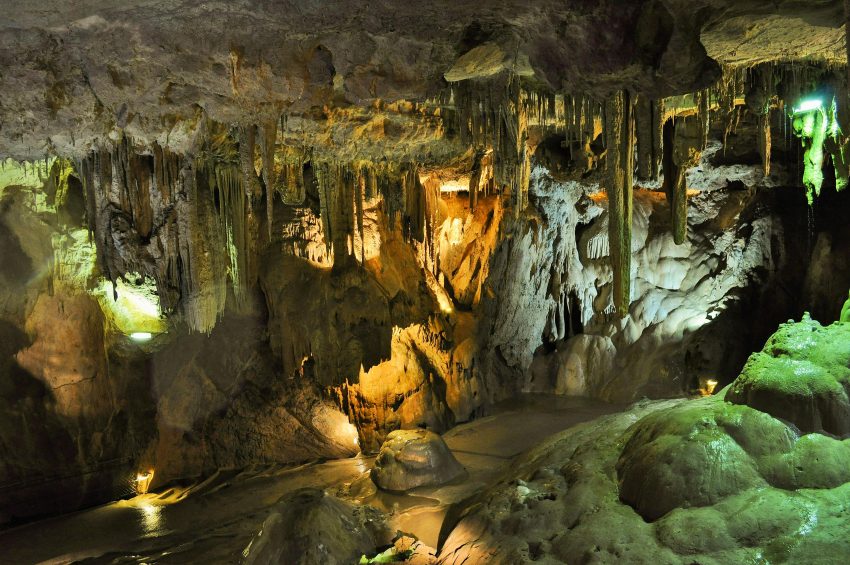
Hidden beneath the foothills between the Pyrénées-Atlantiques and Hautes-Pyrénées, the Grottes de Bétharram reveal an extraordinary underground landscape carved by ancient rivers. Here, visitors descend through several levels of limestone chambers, galleries, and rivers, moving from vast cathedral-like spaces to narrow passages sculpted into fantastical shapes. What makes these caves truly special is the way you explore them: you walk through the upper levels, glide across an underground river by boat, then finish with a small train that brings you back toward the daylight. It feels more like a journey than a simple visit, with each section revealing a different personality of the caves.
Discovered in 1819 and opened to the public in the early 20th century, the Grottes de Bétharram were among the first French caves to be developed for visitors, with artist and photographer Léon Ross introducing guided-tours and electric lighting in 1903. Today, the route showcases spectacular stalactites, stalagmites, draped formations, and spongy ceilings shaped by thousands of years of erosion. Moving from high dry chambers to river-carved tunnels, you get a vivid sense of how water has patiently hollowed out the mountain. With such a rich mix of geology, atmosphere, and clever route design, this is one of the must-see places in Lourdes for anyone who enjoys immersive natural experiences.
Table of Contents
- History and Significance of Grottes de Bétharram, Lourdes
- Things to See and Do in Grottes de Bétharram, Lourdes
- How to Get to Grottes de Bétharram, Lourdes
- Practical Tips on Visiting Grottes de Bétharram, Lourdes
- Where to Stay close to Grottes de Bétharram, Lourdes
- Is Grottes de Bétharram, Lourdes Worth Visiting?
- FAQs for Visiting Grottes de Bétharram
- Nearby Attractions to Grottes de Bétharram
History and Significance of Grottes de Bétharram, Lourdes
The story of the Grottes de Bétharram begins with water slowly dissolving and shaping the limestone massif over immense spans of time. Layer by layer, underground rivers cut channels, widened cracks, and created cavities, eventually forming a multi-level network of caves and galleries. When you walk through the caverns today, you’re following the ghost of those ancient rivers, now mostly diverted or running deeper beneath your feet.
Although local people were likely aware of openings in the rock for centuries, the caves were formally “discovered” in 1819, at a time when Europe was becoming increasingly fascinated by geology and the underground world. Their transformation into a major visitor site came in 1903, when Léon Ross, an artist and early Pyrenean photographer, saw their potential and began to equip the caves for tourism. He installed electric lighting, laid out guided routes, and created the original experience that would evolve into today’s three-part journey by foot, boat, and train.
Over the decades, the Grottes de Bétharram have intrigued scientists and explorers as well as tourists. They offer textbook examples of speleological processes-solution, erosion, sedimentation-alongside delicate formations that highlight how fragile these environments are. The caves' constant 14°C temperature and carefully managed access help preserve this subterranean ecosystem, while allowing visitors to appreciate a side of the Pyrenees that lies entirely out of sight from the mountains' famous peaks and cirques. It is often visited on walking-tours of Lourdes and the wider Béarn-Bigorre region, adding an underground chapter to an otherwise above-ground itinerary.
Things to See and Do in Grottes de Bétharram, Lourdes
A standard visit to the Grottes de Bétharram unfolds in three acts. First comes the walking section: guided groups descend into the upper levels of the cave system, moving through grand halls and galleries where stalactites and stalagmites rise and fall like frozen waterfalls. Electric lighting highlights delicate curtains, columns, and rippled walls, while guides explain how dripping water has slowly built up these formations millimetre by millimetre over thousands of years.
The second act is the underground boat ride. Here, visitors board small craft to glide across a still, dark pool, the surface reflecting hanging formations and rock textures above. The gentle movement and muffled acoustics give this part of the tour a calm, almost dreamlike quality, in sharp contrast with the scale of the chambers you’ve just walked through. It is often the moment that most visitors remember, a quiet pause in the middle of the adventure.
Finally, the route transitions to the small train ride back toward the surface. This 700-metre journey carries you through tunnels and past illuminated rock features, gradually returning you from the depths to daylight. The entire experience typically lasts around 1 hour and 20 minutes, making it easy to combine with other Pyrenean excursions. Between the varied modes of travel and the ever-changing shapes and colours of the rock, it's one of the things to do in Lourdes that appeals to families, casual visitors, and geology enthusiasts alike.
How to Get to Grottes de Bétharram, Lourdes
The Grottes de Bétharram are located between Lourdes and Pau, roughly 15-20 kilometres from Lourdes by road, making them a straightforward excursion from the town. From Lourdes, you follow local roads toward Bétharram, with clear signage pointing the way to the cave entrance and visitor facilities.
If you're arriving in the region by air, the nearest airport is Tarbes-Lourdes-Pyrénées, with additional flight options at Pau and, further afield, Toulouse. For the best deals and a seamless booking experience, check out these flights to Lourdes on Booking.com. From any of these, you can continue by hire car or local transport toward Lourdes and then on to the caves.
By train, Lourdes is the main hub, with regular services linking it to major cities such as Toulouse and Bordeaux.You can use SNCF Connect to check schedules, compare routes, and purchase tickets for National (SNCF ) and regional trains (TER). For a more streamlined experience, we recommend using Omio, which allows you to easily compare prices, schedules, and book tickets for both National and Regional travel across all of Europe, all in one place. From Lourdes, you can reach the Grottes de Bétharram by car, taxi, or seasonal bus services, depending on the time of year; local tourist offices can provide current schedules and options.
If you are driving, the cave complex is easily accessed via regional roads connecting Lourdes, Bétharram, and Pau.If you are looking to rent a car in France I recommend having a look at Discover Cars, first, as they compare prices and review multiple car rental agencies for you. There is parking near the entrance, and the site is well signposted; arriving a little early before your booked tour time gives you a chance to check in, adjust to the cooler cave temperature, and browse any on-site information before heading underground.
Practical Tips on Visiting Grottes de Bétharram, Lourdes
- Suggested tips: Wear comfortable walking shoes with good grip and bring a light jacket or jumper-the cave stays around 14°C year-round, even in summer.
- Best time to visit: Late spring to autumn offers the easiest travel and fuller tour schedules; in high season, booking ahead helps secure your preferred time slot.
- Entrance fee: €17.00
- Opening hours: February 10 – March 7: Open Monday to Thursday at 2:30 PM and 4:00 PM, and Friday at 2:30 PM. March 8 – March 23: Closed. March 24 – July 6: Open daily from 9:30 AM to 12:00 PM and 1:30 PM to 5:00 PM. July 7 – August 24: Open daily from 9:00 AM to 6:00 PM. August 25 – November 2: Open daily from 9:30 AM to 12:00 PM and 1:30 PM to 5:00 PM.
- Official website: https://www.betharram.com/
- How long to spend: Allow around 1.5-2 hours for the full guided tour plus a little extra time at the entrance area for photos, information panels, or a drink.
- Accessibility: The route includes stairs, uneven ground, and confined spaces, so it’s not suitable for all mobility levels; check access information in advance if you have specific needs.
- Facilities: On the surface you’ll usually find parking, ticket office, restrooms, a small shop, and sometimes a café; once in the caves, facilities are minimal by design.
- Photography tip: Low light and mixed illumination mean you’ll want a steady hand or camera with good low-light performance; be respectful of any rules about flash to protect the formations.
- Guided tours: All visits are guided, with explanations about geology and history; tours may be available in multiple languages or with printed translations.
- Nearby food options: Small cafés and restaurants in the surrounding area, as well as in nearby Lourdes or Pau, make it easy to combine the caves with a relaxed lunch or dinner.
Where to Stay close to Grottes de Bétharram, Lourdes
Most visitors choose to stay in Lourdes and visit the Grottes de Bétharram as a half-day excursion. For a comfortable base close to the Sanctuary area and transport links, Hôtel Panorama offers modern rooms and easy access to both the town and the surrounding countryside. Travellers looking for a slightly quieter stay with good views might consider Hôtel Padoue, which combines comfort with convenient access to the centre. If you’d like a more rural feel while still being within reach of both Lourdes and the caves, Le Vieux Logis places you closer to the valley landscape around Bétharram itself.
Is Grottes de Bétharram, Lourdes Worth Visiting?
Grottes de Bétharram are absolutely worth visiting, particularly if you enjoy experiences that combine natural beauty with a touch of adventure. The mix of walking through vast chambers, drifting silently by boat, and returning by underground train makes the tour feel dynamic and memorable rather than static. Add in the cool, constant cave climate, the sense of descending through multiple levels of the earth, and the easy access from Lourdes, and it's clear why this is one of the best places to visit in Lourdes for families, couples, and solo travellers alike. This spot is one of the best places to see in Grottes de Bétharram if you want to understand how water, rock, and time together can create something truly spectacular.
What Other Travellers Say...

Grottes de Bétharram, on Rte des Grottes in Lestelle-Bétharram, offers a well-organized guided visit through extensive caverns with ramps, stairs and paths, alternating live and recorded explanations enhanced by lighting effects; the route ends with a boat trip on an underground river and a short train ride, and there’s a pleasant shop under a glass roof selling stones and jewelry. Visitors praise helpful guides and smooth logistics including bus transfers timed to tickets, and many describe the experience as highly enjoyable and recommended.


FAQs for Visiting Grottes de Bétharram
Nearby Attractions to Grottes de Bétharram
- Lourdes Sanctuary - Major pilgrimage site with basilicas, the Grotto of Massabielle, and peaceful grounds, easily combined with a cave visit in the same trip.
- Pic du Jer - A viewpoint above Lourdes reached by funicular, offering panoramic vistas over the town and surrounding Pyrenees.
- Cirque de Gavarnie - Spectacular glacial amphitheatre with towering cliffs and waterfalls, ideal for a full-day mountain hike.
- Pau Old Town - Elegant Pyrenean city with a historic château, boulevard with mountain views, and a relaxed café culture.
- Pont d’Espagne and Cauterets - Scenic valley with waterfalls, lakes, and marked walking routes showcasing another side of the high Pyrenees.
The Grottes de Betharram appears in our Complete Guide to Visiting Lourdes!

Moira & Andy
Hey! We're Moira & Andy. From hiking the Camino to trips around Europe in Bert our campervan — we've been traveling together since retirement in 2020!
This website uses affiliate links which may earn a commission at no additional cost to you!
Planning Your Visit
February 10 - March 7: Open Monday to Thursday at 2:30 PM and 4:00 PM, and Friday at 2:30 PM.
March 8 - March 23: Closed.
March 24 - July 6: Open daily from 9:30 AM to 12:00 PM and 1:30 PM to 5:00 PM.
July 7 - August 24: Open daily from 9:00 AM to 6:00 PM.
August 25 - November 2: Open daily from 9:30 AM to 12:00 PM and 1:30 PM to 5:00 PM.
€17.00
Nearby Attractions
- Cirque de Gavarnie (46.8) km
National Park - Biarritz Airport (115.6) km
Airport - Magdalena Bridge (122.0) km
Bridge - Centro De Interpretacion De Las Fortificaciones (122.1) km
Castle, City Walls and Museum - Mirador de Caballo Blanco (122.3) km
Viewing Point - Plaza de Toros de Pamplona (122.4) km
Bullring - Catedral de Pamplona (122.4) km
Cathedral - Portal de Francia (122.4) km
City Gate - Albergue de Jesús y María (122.4) km
Church and Hostel - Calle Estafeta (122.5) km
Street