Domus dei Tappeti di Pietra, Ravenna
Historic Site and Museum in Ravenna
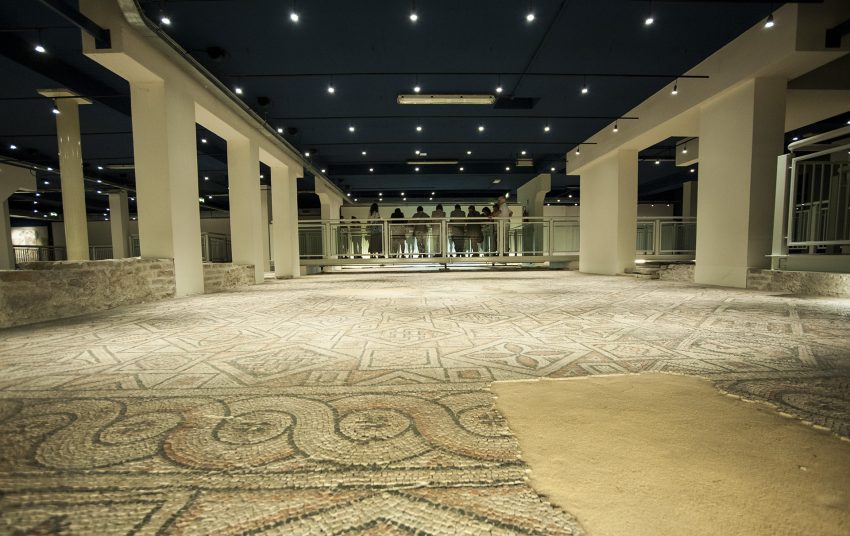
Beneath the late-baroque Church of Sant'Eufemia, Domus dei Tappeti di Pietra reveals one of Ravenna's most surprising experiences: an underground world where mosaic floors and marble inlays stretch out like richly patterned “stone carpets.” It feels part archaeological site, part secret museum, and because you're viewing the rooms from raised walkways, the visit has a cinematic quality, as if you're floating above the private spaces of a long-lost residence.
If you've already seen Ravenna's famous church mosaics, this site offers a completely different perspective, focused on domestic and civic life rather than liturgy. It's one of the top attractions in Ravenna for travellers who want something beyond basilicas, and it's often visited on walking tours of Ravenna because it sits in the centre and delivers a high-impact experience in a relatively short time.
Table of Contents
- History and Significance of the Domus dei Tappeti di Pietra
- Things to See and Do in the Domus dei Tappeti di Pietra
- How to Get to the Domus dei Tappeti di Pietra
- Practical Tips on Visiting the Domus dei Tappeti di Pietra
- Where to Stay close to the Domus dei Tappeti di Pietra
- Is the Domus dei Tappeti di Pietra Worth Visiting?
- FAQs for Visiting Domus dei Tappeti di Pietra
- For Different Travelers
- Nearby Attractions to the Domus dei Tappeti di Pietra
History and Significance of the Domus dei Tappeti di Pietra
The site was discovered in the early 1990s during works connected with an underground parking project, and the scale of what emerged quickly changed how people understood this part of Ravenna. Rather than a single isolated room, excavations uncovered a multi-layered complex showing repeated occupation and rebuilding from the Roman period through the Byzantine era, turning one address into a compressed timeline of the city's changing fortunes.
What visitors often remember most is not a single artefact, but the overall idea: a substantial residential complex, roughly 700 square metres, with a layout of numerous rooms and courtyards that suggests serious wealth and social status. It's commonly described as a kind of Byzantine-era palace residence, likely linked to an elite household in 6th-century Ravenna, when the city carried enormous political and cultural weight.
Its significance also comes from what it preserves. While wall paintings and furnishings rarely survive, floors often do, and here they survive in extraordinary variety and condition. The “stone carpets” of polychrome tesserae and marble inlays aren’t just decoration; they are evidence of taste, economy, craftsmanship, and how spaces were meant to be used and navigated.
Things to See and Do in the Domus dei Tappeti di Pietra
The best way to begin is to orient yourself to the walkway system. You’ll be moving around the perimeter and looking down into rooms, so take a moment to understand how the site is organised and where the largest mosaics sit. This is a place where you get more out of the visit by slowing your pace, because the patterns are dense and the details can disappear if you rush.
Look for the traces of urban layout that still cut through the complex, including the remains of a paved Roman road that helps explain how the site evolved. One of the most fascinating aspects is that what you see today reflects merging and reworking of earlier structures, so the rooms feel like a puzzle assembled over centuries, rather than a perfectly planned “new build.”
The headline mosaic is the banquet hall scene often called the Dance of the Geniuses of the Seasons, where figures embody the rhythm of the year. It’s an immediately readable image even if you have no background knowledge, and it gives the site a human warmth: this was a room for gathering, hosting, and displaying status, and the floor itself was part of that performance.
Also keep an eye out for the reception spaces, where the mosaic designs sometimes play clever games with framing and extension, making the floor feel less like a bordered carpet and more like a living field of pattern. In other areas, figurative elements such as shepherd imagery suggest older symbolic traditions that echo themes you’ll recognise from Ravenna’s religious art, but here they appear in a more domestic, ambiguous context.
How to Get to the Domus dei Tappeti di Pietra
Most visitors arrive in the region via Bologna Guglielmo Marconi Airport, then continue to Ravenna by onward ground transport. For the best deals and a seamless booking experience, check out these flights to Ravenna on Booking.com.
Ravenna is straightforward to reach by train, typically via Bologna, and from Ravenna station you can walk into the historic centre or take a short bus or taxi ride to the area around Via D'Azeglio and Sant'Eufemia. Use Omnio to easily compare schedules, book train tickets, and find the best prices all in one place for a hassle-free journey across Italy.
If you’re driving, aim for parking areas on the edge of the centre and walk in, since central streets can be restricted and the most pleasant approach is on foot through the historic core. If you are looking to rent a car in Italy I recommend having a look at Discover Cars, first, as they compare prices and review multiple car rental agencies for you.
Practical Tips on Visiting the Domus dei Tappeti di Pietra
- Suggested tips: Visit after one or two major basilicas so you can appreciate the contrast between sacred mosaics and domestic mosaics, then take your time with the banquet hall floors.
- Best time to visit: Mid-morning or early afternoon on a weekday, when you’re less likely to be squeezed by groups on the walkways.
- Entrance fee: Adults €4.00
- Opening hours: Daily: 10:00 – 18:30
- Official website: http://www.domusdeitappetidipietra.it/
- How long to spend: 45-75 minutes for a satisfying visit, longer if you enjoy slow viewing and reading the room-by-room interpretation.
- Accessibility: The experience relies on raised walkways and level changes; check current accessibility information if you require step-free routes.
- Facilities: Limited on-site amenities; plan cafés and toilets in the surrounding centre before or after your visit.
- Photography tip: If photography is permitted, aim for a few clean overhead shots that show whole compositions; details can be harder to capture due to distance and lighting.
- Guided tours: A guided visit helps you understand how the complex evolved across centuries and why certain rooms were likely used for reception, dining, and private life.
- Nearby food options: The centre is full of easy lunch and aperitivo options, making it simple to slot this visit between meals.
Where to Stay close to the Domus dei Tappeti di Pietra
To keep this site walkable along with San Vitale, Galla Placidia, and the cathedral cluster, stay in central Ravenna and build a foot-based itinerary. Hotel Bisanzio is a dependable base for reaching the main monuments quickly. For a more boutique stay close to the heart of the centre, Albergo Cappello keeps you near restaurants and evening stroll routes. If you want a comfortable hotel feel while staying central, Palazzo Bezzi Hotel works well for splitting the day between mosaics, museums, and relaxed meals.
Is the Domus dei Tappeti di Pietra Worth Visiting?
Yes, particularly if you want to see Ravenna from a different angle. Many visitors come for church mosaics and leave thinking Ravenna's artistry belongs only to sacred space; this site proves how sophisticated domestic and civic environments could be as well, and it broadens your sense of what “mosaic culture” actually meant in the city.
It is also one of Ravenna’s most memorable experiences because of the setting. Descending beneath a church and finding a preserved world of floors, rooms, and patterns feels like a discovery, even if you arrive knowing exactly what you’ll see. It adds variety to a monument-heavy itinerary and often becomes the unexpected highlight.
FAQs for Visiting Domus dei Tappeti di Pietra
What Other Travellers Say...

Domus dei Tappeti di Pietra, on Via Gian Battista Barbiani beneath the Church of Sant'Eufemia in Ravenna, is an underground archaeological site where well‑preserved Byzantine‑era and late Roman floor mosaics were uncovered during construction; a modern walkway lets you view mosaics across multiple rooms, including a notable scene known locally as the Dance of the Geniuses of the Seasons, and visitors praise the quality and detail of the pieces while noting it's compact and benefits from a guide to get the most from a short visit.


For Different Travelers
Families with Kids
This is a good family-friendly archaeology stop because the viewing walkways create a clear, safe route and the mosaics provide immediate visual interest. Children often enjoy spotting figures in the floors, especially in the larger halls where the designs feel like stories rather than abstract patterns.
Keep the visit moving with a simple plan: pick two or three rooms to focus on, including the Seasons mosaic, then head back above ground for a break. Because it’s underground, some children may appreciate a quick “reset” outside afterward.
Couples & Romantic Getaways
For couples, Domus dei Tappeti di Pietra is a memorable change of pace from basilicas, with a slightly secret, discovery-like feel. The dimmer light and the sense of being below the city create an atmosphere that feels intimate and removed from the everyday bustle.
It also works beautifully as a mid-afternoon visit, followed by aperitivo in the centre. The contrast between underground quiet and lively street life above makes the experience linger.
Budget Travelers
This is a strong value stop because it’s centrally located, easy to reach on foot, and delivers a substantial, distinctive experience without needing transport or a long time commitment. If you’re trying to choose which paid entries to prioritise, this one often feels “different enough” to justify itself alongside one or two major basilicas.
Build a walking route that links it with free city wandering, then use your ticket budget on a short list of interiors that offer variety: one grand basilica, one baptistery, and this underground domestic mosaic site is a balanced trio.
History Buffs
History-focused travellers tend to love this site because it captures Ravenna as a lived city, not only as a sacred showcase. The multi-period layers and the evidence of reworking and merging structures offer a compact case study in how urban spaces evolve over centuries.
The floors are also historical documents in their own right. They reflect taste, wealth, and identity, and they show how late antique elites used art to shape social space, from reception rooms to banquet halls, in ways that parallel but also differ from the city’s religious monuments.
Nearby Attractions to the Domus dei Tappeti di Pietra
- Basilica of San Vitale: Ravenna's most celebrated mosaic interior and one of the city's essential UNESCO monuments.
- Mausoleum of Galla Placidia: A small building with a starry mosaic dome and a uniquely intimate atmosphere.
- National Museum of Ravenna: A monastery-based museum with archaeology, Byzantine sculpture, ivories, and applied arts beside San Vitale.
- MAR – Ravenna Art Museum: A contemporary museum in a Renaissance cloister, strong for modern mosaics and rotating exhibitions.
- Dante's Tomb: A quiet central memorial stop that adds a reflective, literary layer to a Ravenna walking day.
The Domus dei Tappeti di Pietra appears in our Complete Guide to Visiting Ravenna!

Moira & Andy
Hey! We're Moira & Andy. From hiking the Camino to trips around Europe in Bert our campervan — we've been traveling together since retirement in 2020!
This website uses affiliate links which may earn a commission at no additional cost to you!
Planning Your Visit
Daily: 10:00 - 18:30
Adults €4.00
Nearby Attractions
- National Museum of Ravenna (0.2) km
Historic Building and Museum - Basilica of San Vitale (0.2) km
Basilica - Mausoleum of Galla Placidia (0.3) km
Mausoleum - Ravenna Cathedral (0.4) km
Cathedral - Piazza del Popolo (0.4) km
Square - Neonian Baptistery (0.4) km
Baptistery - Archbishop's Chapel of St. Andrew (0.5) km
Church - Archbishop's Museum (0.5) km
Museum - Museo Dante (0.6) km
Historic Building and Museum - Dante’s Tomb (0.6) km
Tomb