Dahshūr, Cairo
Historic Site near Cairo
The 12th dynasty (1938-c. 1756 BCE) constructed the remaining three pyramids at Dahshūr, which are not well preserved as their inner cores were mostly constructed with mud bricks. The tombs of the royal families situated near these pyramids included an impressive collection of jewelry and personal items. Some scholars consider these artifacts to represent the pinnacle of development in Egyptian metalworking and lapidary art. One notable discovery made at Dahshūr was the jewelry cache of Queen Weret, uncovered in 1994 during excavations by the Metropolitan Museum of Art.Dahshūr is an ancient pyramid site located on the west bank of the Nile River, just south of Ṣaqqārah in northern Egypt. Together with other nearby ruins such as Abū Ṣīr, Ṣaqqārah, Abū Ruwaysh, and the Pyramids of Giza, it was collectively designated a UNESCO World Heritage site in 1979.
Two of the five remaining pyramids at Dahshūr were constructed during the 4th dynasty (c. 2575-c. 2465 BCE) under the reign of King Snefru (reigned 2575-51).
Bent Pyramid
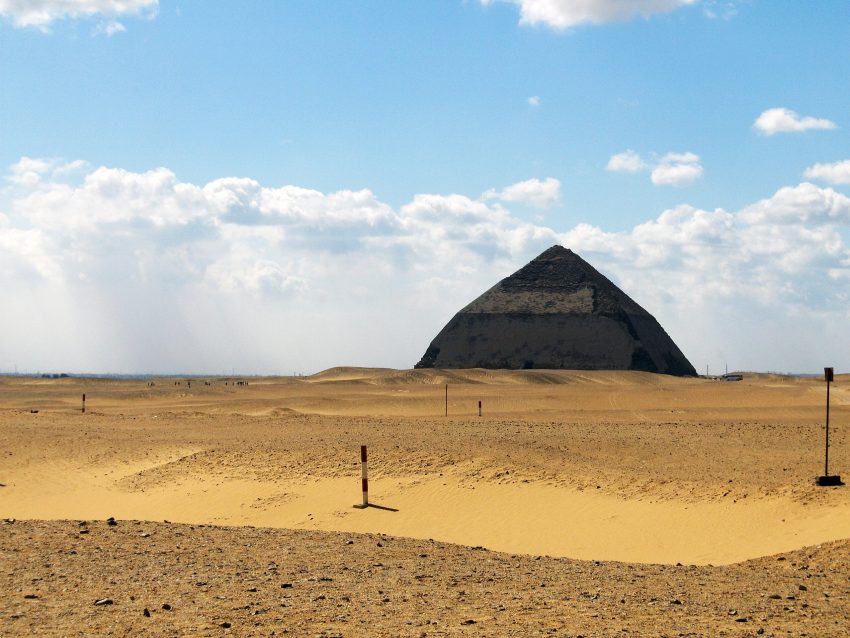
The first pyramid, known as the Blunted, Bent, False, or Rhomboidal Pyramid, features a unique double slope. This pyramid was an early attempt to construct a true pyramid, but the initial angle of slope (52°) was found to be too steep, and so the top portion was reduced to 43.5°. It is the best-preserved pyramid at Dahshūr and the only Old Kingdom (c. 2575-c. 2130 BCE) pyramid with two entrances.
Red Pyramid
The second pyramid, called the North Pyramid (Red Pyramid), was also built by Snefru and has a lower slope angle of 43°, making it shorter than the Blunted Pyramid. This pyramid is the first successfully completed true pyramid. This pyramid gets its name from the red limestone, the material that was used to construct this pyramid.
Going inside the Pyramids
Visitors now have the opportunity to venture inside both pyramids at Dahshūr, with the Bent Pyramid reopening to the public in 2019 after being closed since the 1960s.
To enter the pyramid, visitors must first ascend a series of steps since the entrance sits above ground level. They then descend a long, narrow tunnel, which is not tall enough to stand up in, requiring visitors to hunch over until they reach the bottom. Despite the winter season, the interior chambers can be uncomfortably hot and humid. Each pyramid contains multiple chambers to explore. Visitors to the Bent Pyramid may also encounter bats within its chambers.
Remaining three pyramids at Dahshūr
The 12th dynasty (1938-c. 1756 BCE) constructed the remaining three pyramids at Dahshūr, which are not well preserved as their inner cores were mostly constructed with mud bricks. The tombs of the royal families situated near these pyramids included an impressive collection of jewelry and personal items. Some scholars consider these artifacts to represent the pinnacle of development in Egyptian metalworking and lapidary art. One notable discovery made at Dahshūr was the jewelry cache of Queen Weret, uncovered in 1994 during excavations by the Metropolitan Museum of Art.
What Other Travellers Say...

Bent Pyramid, located in Badrshein, Giza Governorate, is an unusually shaped Old Kingdom pyramid noted for its change of angle and well-preserved outer limestone casing; visitors describe a peaceful, uncrowded site with wide desert views that include nearby pyramids and ruins. The interior is accessible but narrow and steep—expect long, physically demanding descents and ascents through corbelled chambers and interconnected passages, and take care if you have mobility or breathing issues. Because it’s quieter and harder to reach than the Giza Plateau, you’re likely to have more space for photos and contemplation, though some onsite staff may press for tips.


The Dahshūr appears in our Complete Guide to Visiting Cairo!

Moira & Andy
Hey! We're Moira & Andy. From hiking the Camino to trips around Europe in Bert our campervan — we've been traveling together since retirement in 2020!
This website uses affiliate links which may earn a commission at no additional cost to you!
Nearby Attractions
- Memphis (7.9) km
Historic Site - Saqqara (8.7) km
Historic Site - Pyramids of Giza (22.2) km
Historic Site - Cairo Tower (28.4) km
Tower - The Egyptian Museum (28.8) km
Museum - Valley of the Kings (470.7) km
Historic Site - Karnak Temple Complex (474.6) km
Historic Site - Luxor Temple (476.1) km
Historic Site