Neonian Baptistery, Ravenna
Baptistery in Ravenna
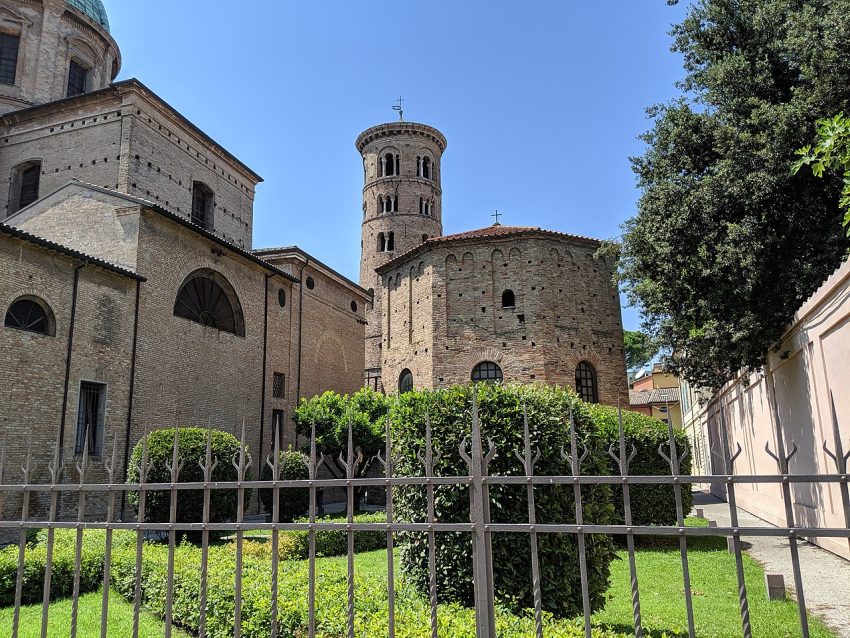
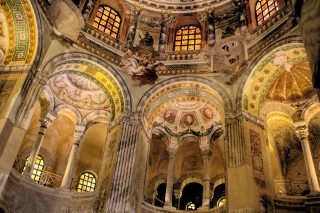
Just steps from Ravenna's Cathedral, the Neonian Baptistery, also called the Orthodox Baptistery, looks understated from the outside: bare brick, an octagonal footprint, and a sense that you're approaching something ancient rather than theatrical. Then you step inside and the effect is immediate. Light, colour, and shimmering mosaic pull your gaze upward, and it becomes easy to understand why visitors have described the space as almost unreal.
For most travellers, this is one of the top attractions in Ravenna because it delivers a concentrated “Ravenna mosaic” moment without requiring a long visit. It's also a great place to visit on a walking tour of Ravenna, since it sits in the cathedral area and pairs naturally with nearby churches and museums in the same compact part of the centre.
Table of Contents
- History and Significance of the Neonian Baptistery
- Things to See and Do in the Neonian Baptistery
- Practical Tips on Visiting the Neonian Baptistery
- Where to Stay close to the Neonian Baptistery
- Is the Neonian Baptistery Worth Visiting?
- FAQs for Visiting Neonian Baptistery
- For Different Travelers
- Nearby Attractions to the Neonian Baptistery
History and Significance of the Neonian Baptistery
The baptistery likely dates to the early 5th century, when Ravenna rose to exceptional importance as the capital of the Western Roman Empire. It is associated with Bishop Ursus as the original patron, and then with Bishop Neon, who oversaw significant restoration and decoration work in the mid-5th century. That second phase is crucial, because much of what makes the baptistery extraordinary today-the cupola's decorative programme and the enduring brilliance of the interior-was shaped under Neon's intervention.
Unlike many baptisteries of the 4th and 5th centuries that survive only as fragments or heavily altered shells, the Neonian Baptistery remains unusually intact both architecturally and ornamentally. That integrity is part of its UNESCO importance: you are not looking at a reconstructed idea of late antique baptismal space, but something that still reads as a coherent, immersive environment.
The baptistery’s significance also lies in its iconography. The dome’s baptism scene is often described as the earliest known depiction of the baptism of Christ within a monumental setting of this kind, and the surrounding imagery works like a theological spiral, guiding your gaze from symbolic motifs at the edges toward the central revelation above the font.
Things to See and Do in the Neonian Baptistery
Begin by standing near the centre and looking up without moving for a moment. The dome is designed to pull your eye inward and upward, and you’ll understand the logic of the decoration more clearly if you let it unfold slowly rather than scanning it like a checklist. The octagonal plan reinforces that sense of contained ceremony, as if the entire space is a single architectural gesture.
The dome’s design is organised in rings, and it’s worth reading it from the outside band toward the centre. In the outer strip you’ll notice repeated sections that alternate between natural motifs and symbolic elements such as thrones and altar imagery. Move inward to the middle band and find the twelve apostles, marching in a circle in two processions led by Peter and Paul, their laurel wreaths creating a rhythm of triumph and continuity around the dome.
At the centre, the baptism of Christ anchors everything: Christ stands in the waters of the Jordan, John the Baptist beside him, and the scene feels both intimate and monumental because it is placed exactly where everyone in the room naturally looks. After you’ve taken it in from the centre, walk slowly around the perimeter and look up again from different angles. The mosaics change as you move, not only because of perspective, but because light catches tesserae differently with each step.
Before you leave, look down to the baptismal font in the centre. The octagonal basin, rebuilt in the 6th century while preserving older fragments, grounds the entire experience in physical ritual. It’s a reminder that this was not created as an art display; it was built to be used, and the art above it was meant to elevate a real moment of transformation.
Practical Tips on Visiting the Neonian Baptistery
- Suggested tips: Pause in the centre first, then do a slow circuit; the dome makes more sense when you experience it in that order.
- Best time to visit: Early morning or later afternoon for fewer groups and a calmer, more contemplative atmosphere.
- Entrance fee: €10.50 - The combined ticket includes the entry to Basilica of Sant'Apollinare Nuovo, Neonian Baptistery (**), Basilica of San Vitale, Mausoleum of Galla Placidia (**) and Archiepiscopal Museum and Chapel.
- Opening hours: Winter: Daily: 10:00 – 17:00; Summer: Daily: 09:00 – 19:00
- Official website: http://www.ravennamosaici.it/
- How long to spend: 20-40 minutes, longer if you enjoy studying iconography and returning to the dome from multiple viewpoints.
- Accessibility: Expect historic thresholds and possible level changes; check current step-free access routes if you need them.
- Facilities: Limited on-site amenities; the cathedral area and nearby streets have cafés, toilets, and services within a short walk.
- Photography tip: If photography is permitted, avoid flash and prioritise a centred shot of the dome; low light makes quick close-ups less satisfying.
- Guided tours: A guide is especially helpful here because the dome’s ring structure and symbolism are more rewarding when you understand what you’re seeing.
- Nearby food options: This is a perfect stop to pair with a café break immediately after; the area around the centre is full of easy options.
Where to Stay close to the Neonian Baptistery
Staying in central Ravenna keeps the baptistery and the broader monument cluster walkable, which is especially useful if you want to visit at quieter times. Albergo Cappello is a characterful base close to the cathedral area and evening dining streets. Hotel Centrale Byron is a practical, central option that makes it easy to reach sights early. For a slightly more polished hotel feel while still staying walkable to the baptistery, Palazzo Bezzi Hotel is a comfortable choice.
Is the Neonian Baptistery Worth Visiting?
Yes, without hesitation. Ravenna offers many mosaic masterpieces, but few experiences are as immediate as standing beneath this dome and feeling the space close around you like a vessel of colour and light. The visit is short, but it can be surprisingly affecting, especially if you give yourself permission to simply stand still and look up.
It's also a particularly smart choice if you are limited on time. The baptistery delivers a complete Ravenna “signature experience” in under an hour, and it sits in a cluster where you can build an entire day without needing transport.
FAQs for Visiting Neonian Baptistery
What Other Travellers Say...

Battistero Neoniano (o degli Ortodossi) on P.za Arcivescovado 1 in Ravenna is an intimate octagonal baptistery famed for its richly preserved Byzantine mosaics; inside visitors find a glowing dome mosaic of Christ's baptism surrounded by the twelve apostles, a central marble and porphyry baptismal font, and marble and stucco arcades with prophet figures and decorative motifs, making the small exterior give way to a spectacular interior—many recommend booking ahead and taking time to look up at the dome.


For Different Travelers
Families with Kids
This is a strong family visit because the “wow” moment is immediate: you walk in and the ceiling feels like a storybook sky. Keep kids engaged by turning the dome into a quick game-spot Christ in the centre, find John the Baptist, then count the apostles walking in a circle.
Because the space is compact, plan the visit as a short, focused stop rather than a long one. Follow it with a break outside so children can reset, especially if you have more indoor monuments planned that day.
Couples & Romantic Getaways
For couples, the Neonian Baptistery is one of Ravenna's most intimate experiences, particularly at quieter times when you can stand in the centre without being hurried. The dome has a romantic, almost cinematic quality, where the sense of enclosed light and colour makes the city feel timeless.
It also fits perfectly into a slow itinerary. Visit early, then walk to a café nearby and let the experience linger over breakfast or a late espresso before continuing to the next site.
Budget Travelers
The baptistery is a high-value stop because it delivers one of Ravenna’s most iconic interiors in a short time and in a central location, so you won’t spend anything extra getting there. If you are using combined tickets, it often fits naturally into a day where you see several monuments on foot.
To keep costs down, structure your day around walkable clusters like the cathedral area, and balance paid interiors with free wandering through Ravenna’s streets and piazzas.
History Buffs
History-focused travellers often appreciate how clearly the baptistery embodies Ravenna's early 5th-century status and its evolving Christian identity. The association with the period when Ravenna served as imperial capital, and the later interventions under Bishop Neon, make it a compact case study in how patronage, theology, and art interacted.
The dome’s iconographic “ascent” is also worth reading as a deliberate theological structure, culminating above the very font where the ritual of baptism took place. It is a rare moment where architecture, imagery, and function align so perfectly that the space still feels legible across fifteen centuries.
Nearby Attractions to the Neonian Baptistery
- Ravenna Cathedral: A central landmark that anchors the baptistery area and adds context to Ravenna's later ecclesiastical development.
- Archbishop's Museum: A compact museum with the Chair of Bishop Maximian and cathedral treasures, ideal for pairing in the same cluster.
- Basilica of San Vitale: Ravenna's most celebrated mosaic interior and a cornerstone of the city's UNESCO heritage.
- Mausoleum of Galla Placidia: A small, starry mosaic masterpiece with an unforgettable intimate atmosphere.
- Basilica of Sant'Apollinare Nuovo: A long-nave basilica famed for its mosaic processions and its layered Arian-to-Orthodox history.
The Neonian Baptistery appears in our Complete Guide to Visiting Ravenna!

Moira & Andy
Hey! We're Moira & Andy. From hiking the Camino to trips around Europe in Bert our campervan — we've been traveling together since retirement in 2020!
This website uses affiliate links which may earn a commission at no additional cost to you!
Planning Your Visit
Winter: Daily: 10:00 - 17:00; Summer: Daily: 09:00 - 19:00
€10.50 – The combined ticket includes the entry to Basilica of Sant’Apollinare Nuovo, Neonian Baptistery (**), Basilica of San Vitale, Mausoleum of Galla Placidia (**) and Archiepiscopal Museum and Chapel.
Nearby Attractions
- Archbishop's Museum (0.1) km
Museum - Ravenna Cathedral (0.1) km
Cathedral - Archbishop's Chapel of St. Andrew (0.1) km
Church - Basilica of San Francesco (0.3) km
Basilica - Dante’s Tomb (0.3) km
Tomb - Museo Dante (0.3) km
Historic Building and Museum - Piazza del Popolo (0.3) km
Square - Domus dei Tappeti di Pietra (0.4) km
Historic Site and Museum - National Museum of Ravenna (0.5) km
Historic Building and Museum - Arian Baptistery (0.5) km
Baptistery