Baptistery of Parma
Baptistery in Parma
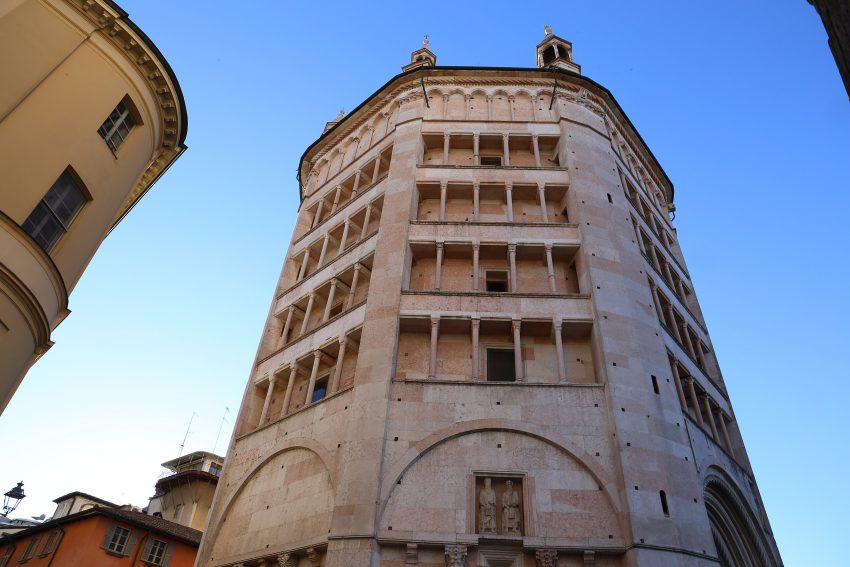
In the heart of Parma, just steps from the cathedral, the pink marble Baptistery stands like a jewel box of stone, catching the light with its warm Verona marble and intricate tiers of loggias, arches and pinnacles. This octagonal baptistery marks the transition from Romanesque solidity to Gothic verticality in northern Italy, and from the outside alone you can read centuries of changing tastes and techniques. Construction began in 1196 under Lombard builders who were also working on the cathedral, and the structure was finally completed in the early 14th century, giving the building time to absorb both styles into its design.
Yet it is the sculpture that truly sets the Baptistery of Parma apart. Much of the decorative programme was created under Benedetto Antelami, whose medieval iconography fills the façade with biblical scenes, symbolic creatures and cosmic motifs. The lower register is a continuous zoophorus of bas-relief carving, populated by animals, mythical beings, sea monsters, centaurs, mermaids, unicorns and zodiac signs, while the three great portals show episodes from the life of Christ, the Virgin and allegories of judgement and human existence. Inside, a serene sixteen-sided space holds Antelami's sculpted Months, Seasons and Zodiac, crowned above the altar by a Christ in Glory surrounded by the four evangelists and angels, making this one of the must-see places in Parma and a highlight of any walking tour of Parma focused on art and architecture.
Table of Contents
- History and Significance of the Baptistery of Parma
- Things to See and Do in the Baptistery of Parma
- How to Get to the Baptistery of Parma
- Practical Tips on Visiting the Baptistery of Parma
- Where to Stay close to the Baptistery of Parma
- Is the Baptistery of Parma Worth Visiting?
- FAQs for Visiting Baptistery of Parma
- Nearby Attractions to the Baptistery of Parma
History and Significance of the Baptistery of Parma
The Baptistery of Parma was begun in 1196, a period when Romanesque architecture still dominated but Gothic ideas were beginning to filter into Italy. Lombard builders, already engaged on the cathedral works next door, laid out an octagonal plan in Verona marble, creating a solid, almost fortress-like base that would gradually be elaborated into something more vertical and ornate. Over the next century, the building rose tier by tier, each level adding new layers of loggias, arches and pinnacles that pulled the eye upwards and hinted at the Gothic love of height and rhythm.
Between 1302 and 1307, under the supervision of Benedetto Antelami, the baptistery’s sculptural and decorative programme took on its definitive form. Antelami, one of the most important sculptors of his age, executed much of the figural carving, drawing on medieval iconography to weave together biblical stories, cosmic cycles and moral allegories. The result is a building that does more than house a baptismal font: it tells a vast visual story about creation, time, salvation and human destiny, all on a compact yet richly detailed canvas.
The baptistery's significance lies not only in its age and craftsmanship, but in its transitional character. It is a textbook example of how Romanesque and Gothic styles overlap rather than abruptly replace one another: heavy walls and strong horizontals coexist with open loggias, pointed rhythms and a more complex, layered façade. Together with the cathedral, it forms the spiritual and artistic heart of Parma, drawing visitors who want to see how local stone, light and imagination combined to create one of Italy's most distinctive sacred buildings.
Things to See and Do in the Baptistery of Parma
Begin with a slow walk around the exterior, noting the octagonal shape and the four tiers of open loggias that encircle the upper levels. Above these, a row of blind arches and pinnacles gives the structure a lace-like skyline, especially striking in early morning or late afternoon light when shadows emphasise every recess and column. The Verona marble, often described as pink, shifts in tone as the light changes, giving the building a subtle, almost living quality.
At eye level, focus on the zoophorus that runs along the lower part of the baptistery. This sculpted frieze is an extraordinary bestiary in stone, with bas-relief figures of real and mythical creatures mingling together: animals and sea monsters, centaurs and mermaids, unicorns and hybrid beings, alongside representations of Hell and the Zodiac. You could easily spend half an hour just tracing these figures with your eyes, spotting new details and trying to decode their symbolic meanings within medieval cosmology.
Then visit each of the three main portals in turn. The north door, the Portale della Vergine, is devoted to the Virgin and key episodes such as the Annunciation and Adoration of the Magi, framed by the twelve prophets and the Trees of Jacob and Jesse, with the Tree of Life on the inner face. The west door, the Portale del Giudizio, presents the Redeemer in the lunette, focusing on judgement and salvation, while the south door, the Portale della Vita, offers a more allegorical scene: a man eating honey in a tree as two rodents and a dragon threaten him from below, with the chariots of the Sun and Moon flanking the composition. Taken together, these portals form a multifaceted meditation on life, faith and eternity.
Inside, the baptistery opens into a surprising sixteen-sided polygonal space, its geometry subtly modifying the octagonal exterior. Here, Benedetto Antelami’s sculpted cycles of the Months, Seasons and Signs of the Zodiac line the interior, linking the sacrament of baptism with the passage of time and the turning of the year. Above the altar, the semi-dome holds a powerful Christ in Glory, encircled by the symbols of the four evangelists and two angels. Stand quietly in the centre and let your eyes travel upwards, then around; the space feels both intimate and expansive, a carefully composed microcosm of the medieval universe.
How to Get to the Baptistery of Parma
The Baptistery of Parma stands on Piazza Duomo in the historic centre, immediately beside the Cattedrale di Parma, so once you are in Parma you are already close. Parma has its own small airport and is also conveniently reached from larger hubs such as Bologna or Milan, with onward travel by train, coach or car into the city. For the best deals and a seamless booking experience, check out these flights to Parma on Booking.com. From the station or bus stops, you can walk or take a short taxi ride into the old town and follow signs to Piazza Duomo.
If you are travelling by train within Italy, Parma sits on major rail lines connecting Milan, Bologna and other northern cities, making it an easy stop on a regional itinerary.Use Omnio to easily compare schedules, book train tickets, and find the best prices all in one place for a hassle-free journey across Italy. From the railway station, the walk into the historic centre takes roughly 15-20 minutes along well-marked streets, or you can use local buses to reach the vicinity of the cathedral and baptistery more quickly.
Arriving by car, you will likely use the A1 motorway and follow signs towards Parma’s centro storico, then leave your vehicle in one of the perimeter car parks, as the streets around Piazza Duomo are largely pedestrian.If you are looking to rent a car in Italy I recommend having a look at Discover Cars, first, as they compare prices and review multiple car rental agencies for you. From your parking spot, it is a short stroll through narrow lanes to the square, where the pink marble baptistery immediately catches the eye beside the cathedral’s façade.
Practical Tips on Visiting the Baptistery of Parma
- Suggested tips: Visit both the baptistery and the cathedral in one trip so you can see how their architecture and decoration dialogue with one another across the shared square.
- Best time to visit: Late morning or mid-afternoon usually offers good interior light and manageable numbers of visitors; early evening can be especially atmospheric outside.
- Entrance fee: € 12,00 Diocesan museum & Baptistery
- Opening hours: Open every day from 10am to 6pm* (* last admission 5.30pm)
- Official website: http://www.piazzaduomoparma.com/
- How long to spend: Allow 30-60 minutes inside to appreciate the portals, zoophorus, interior sculptures and painted decoration without rushing.
- Accessibility: The baptistery is in a pedestrian square and generally easy to reach, but there may be steps at the entrance and around the interior; visitors with reduced mobility should check current access arrangements.
- Facilities: Facilities are limited within the baptistery itself; information desks and basic services can be found nearby, and cafés and shops are scattered around the surrounding streets.
- Photography tip: Outside, capture the full height from a corner of the square to show all four tiers of loggias and pinnacles; inside, focus on details of Antelami’s Months and Zodiac as well as wide shots of the Christ in Glory above the altar.
- Guided tours: Consider a guided visit to the baptistery and cathedral together; a knowledgeable guide can unpack the symbolic programmes of the portals and interior cycles.
- Nearby food options: After your visit, step into one of the nearby cafés or trattorias around Piazza Duomo or in the adjacent streets to sample Parma’s renowned cured meats, cheeses and pasta dishes.
Where to Stay close to the Baptistery of Parma
Staying near Piazza Duomo lets you experience the baptistery in different lights and revisit its details at leisure. For a truly privileged location, Palazzo Dalla Rosa Prati places you right on the cathedral square, giving you views of the baptistery almost from your doorstep. A refined option within walking distance of the historic core is Grand Hotel de la Ville Parma, which offers modern comfort and an easy stroll into the old town for evening visits. For a more intimate, central stay on traditional streets, Hotel Button provides characterful accommodation within a short walk of the baptistery, cathedral and main shopping and dining areas.
Is the Baptistery of Parma Worth Visiting?
The Baptistery of Parma is absolutely worth visiting, especially if you have any interest in medieval and early Gothic art or in richly symbolic religious spaces. Its pink Verona marble exterior, layered with loggias and pinnacles, is beautiful in its own right, but the true fascination lies in Benedetto Antelami's carvings and the way they weave together animals, zodiac signs, months and biblical stories. Inside, the unusual sixteen-sided plan and the Christ in Glory above the altar give the space a quiet intensity that contrasts nicely with the busier streets outside. When combined with the cathedral next door, the baptistery turns Piazza Duomo into one of the most rewarding corners of Parma.
What Other Travellers Say...

Baptistery of Parma, on Piazza Duomo in Parma, is a pink‑marble octagonal baptistery filled with medieval frescoes, carvings and sculptures; visitors praise its vivid wall and ceiling paintings, impressive central baptismal font and intricate bas‑reliefs, and call it a standout example of the Romanesque–Gothic transition. Tickets (often sold at the diocesan museum across the square and sometimes available as a combo with the cathedral and museum) are required for entry; photos and video are generally allowed inside.


FAQs for Visiting Baptistery of Parma
Nearby Attractions to the Baptistery of Parma
- Cattedrale di Parma: The adjoining Romanesque cathedral with Correggio's famous Assumption of the Virgin fresco in the dome.
- Palazzo della Pilotta: Extensive historic complex housing museums, courtyards and cultural institutions, a short walk from Piazza Duomo.
- Teatro Farnese: Spectacular early 17th century wooden theatre inside the Pilotta complex, rebuilt after wartime damage and open to visitors.
- Piazza Garibaldi: Central civic square with historic buildings, cafés and shops, ideal for a break after sightseeing.
- National Gallery of Parma: Art museum within the Pilotta complex, showcasing works from the Middle Ages to the 19th century, including contributions from local masters.
The Baptistery of Parma appears in our Complete Guide to Visiting Parma!

Moira & Andy
Hey! We're Moira & Andy. From hiking the Camino to trips around Europe in Bert our campervan — we've been traveling together since retirement in 2020!
This website uses affiliate links which may earn a commission at no additional cost to you!
Planning Your Visit
Open every day from 10am to 6pm* (* last admission 5.30pm)
€ 12,00 Diocesan museum & Baptistery
Nearby Attractions
- Cattedrale di Parma (0.1) km
Cathedral - Diocesan Museum (0.1) km
Museum - Monastic Complex of San Giovanni Evangelista (0.1) km
Monastery - Chamber of St. Paul and Cell of St. Catherine (0.2) km
Monastery - Basilica Santa Maria della Steccata (0.2) km
Basilica - Regio Theatre (0.3) km
Historic Building and Theatre - Piazza Garibaldi (0.3) km
Square - Pilotta Palace (0.4) km
Museum and Palace - Teatro Farnese (0.4) km
Historic Building and Theatre - Parco Ducale (0.9) km
Park