Baphuon, Siem Reap
Buddhist Temple in Siem Reap
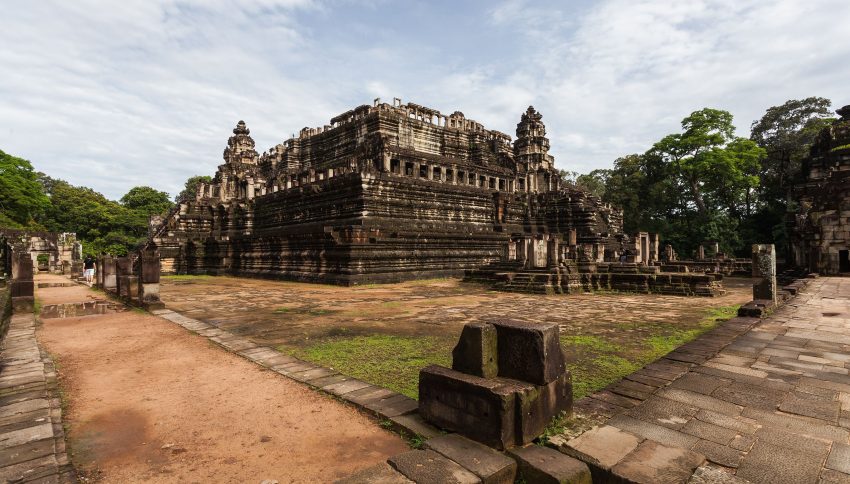
The Baphuon is a temple located in Angkor, Cambodia, within the boundaries of Angkor Thom, to the northwest of the Bayon temple. Known as the “Golden Mountain” (Svarnādrī), the Baphuon is constructed on an artificial hill. Initially dedicated to the Hindu god Shiva, it was later converted into a Theravada Buddhist temple. The dating of the temple has been debated, but recent findings, including the use of AMS Carbon-14 dating in 2015 on iron crampons within the structure, have shown that the temple’s construction predates earlier assumptions. It is now recognized as a major temple built during the reign of Suryavarman I (1010-1050 CE), a king who had no other temple previously associated with his rule.
History of Baphuon Temple
The Baphuon, built in the mid-11th century, is a three-tiered temple mountain that served as the state temple of Suryavarman I and was originally dedicated to Shiva. It is a prime example of the Baphuon style, with intricate carvings adorning its surfaces. The temple is located next to the southern enclosure of the royal palace, measuring 120 meters east-west and 100 meters north-south at its base, standing 34 meters tall without its tower, which would have added an additional 16 meters, bringing its total height to around 50 meters. Its striking appearance reportedly left a lasting impression on Zhou Daguan, a Chinese envoy who visited in the late 13th century, describing it as a “Tower of Bronze” and an “astonishing spectacle” with more than ten chambers at its base.
Later, the Baphuon was modified for Theravada Buddhism, including the addition of a reclining Buddha statue. AMS Carbon-14 dating confirms that this transformation occurred during the Ayutthayan occupation of Angkor around 1430-1440 CE, during a period of significant political and religious upheaval.
The reclining Buddha statue, 9 meters tall and 70 meters long, was built on the second level's west side, likely requiring the destruction of the 8-meter-high tower above it for building materials. The Baphuon was built on unstable sandy land, and large portions of the temple had likely collapsed before the Buddha was added.
The temple, once surrounded by a 125 by 425-meter wall, likely featured a gilded wooden central tower, which has not survived. By the 20th century, the temple had largely collapsed. Restoration efforts were initiated in the mid-20th century, but were halted due to the Cambodian civil war in 1970. Workers had dismantled the temple and carefully labeled and organized 300,000 blocks across 10 hectares, but these plans were lost during the Khmer Rouge period.
A second restoration project began in 1996 under the direction of architect Pascal Royère from the EFEO (French School of the Far East). The restoration process, which became known as the “largest 3D jigsaw puzzle in the world,” took 16 years to complete. In April 2011, after 51 years of work, the temple was officially reopened, with King Norodom Sihamoni of Cambodia and Prime Minister François Fillon of France among the first to tour the restored site during its inauguration on July 3, 2011.
What Other Travellers Say...

Baphuon Temple in the Angkor Archaeological Park is an imposing pyramid-style, mountain-like temple noted for its steep climbs, long elevated walkway and detailed stone carvings; visitors praise the peaceful, less-crowded atmosphere and say the ascent to the upper terrace is well worth it for the panoramic views over the jungle and surrounding ruins.


The Baphuon appears in our Complete Guide to Visiting Siem Reap!

Moira & Andy
Hey! We're Moira & Andy. From hiking the Camino to trips around Europe in Bert our campervan — we've been traveling together since retirement in 2020!
This website uses affiliate links which may earn a commission at no additional cost to you!
Planning Your Visit
Nearby Attractions
- Phimeanakas (0.2) km
Buddhist Temple - Terrace of the Elephants (0.3) km
Historic Site - Prasat Bayon (0.4) km
Buddhist Temple - Bayon Temple (0.4) km
Buddhist Temple - Terrace of the Leper King (0.5) km
Historic Site - Preah Palilay (0.6) km
Buddhist Temple - Victory Gate of Angkor Thom (1.8) km
City Gate - Kmoch Gate (Gate of the Dead) (1.8) km
City Gate - South Gate of Angkor Thom (1.8) km
City Gate - Angkor Thom North Gate (1.3) km
City Gate