Arena di Verona
Amphitheatre in Verona

The Arena di Verona rises straight out of Piazza Bra like a piece of living antiquity, its pale stone arcades and vast oval footprint making it impossible to miss once you step into the historic centre. Built as a Roman amphitheatre and still used as a performance venue, it's the kind of landmark that feels both monumental and strangely approachable: you can circle it in minutes, but it can hold your attention for hours.
More than a photo stop, it's one of the must-see places in Verona because it connects the city's ancient past to its modern cultural heartbeat, especially when the stage is set for summer productions. It also fits naturally into a walking tour of Verona, since the arena sits at the edge of the old town's main routes and pairs easily with nearby squares, churches, and river viewpoints.
Table of Contents
- History and Significance of the Arena di Verona
- Things to See and Do in the Arena di Verona
- How to Get to the Arena di Verona
- Practical Tips on Visiting the Arena di Verona
- Where to Stay Close to the Arena di Verona
- Is the Arena di Verona Worth Visiting?
- For Different Travelers
- FAQs for Visiting Arena di Verona
- Nearby Attractions to the Arena di Verona
History and Significance of the Arena di Verona
The Arena di Verona dates to the Roman era, built in the 1st century AD when Verona was an important city on imperial routes across northern Italy. Like other great amphitheatres, it was engineered for spectacle: an elliptical plan, rising tiers, and internal corridors designed to move large crowds efficiently, proving that Roman beauty often comes from structure and function working as one.
Over the centuries, the arena’s survival has been shaped as much by nature and reuse as by preservation. Earthquakes and stone-robbing altered its outer ring, leaving the famous “wing” section as a distinctive reminder that even the best-built monuments have lived complicated lives. From the 16th century onward, systematic restorations helped stabilise what remained and allowed the building to keep its identity as a readable, walkable amphitheatre rather than a ruin.
Its modern fame is inseparable from performance. Since 1913, the Arena has hosted the open-air opera festival that turned Verona into a global summer stage, and the venue continues to attract major singers and international concerts through the year. That continuity is what makes the Arena feel so alive: it is ancient stone still doing what it was built to do, just in a new cultural language.
Things to See and Do in the Arena di Verona
Start with a slow circuit of the exterior in Piazza Bra, where you can appreciate the scale and the texture of the stonework before stepping inside. The best first impression comes from noticing how the arena's curves dominate the square without overwhelming it, creating a dramatic “arrival” space that sets the tone for central Verona.
Inside, climb into the seating tiers to understand the amphitheatre’s geometry and sightlines. Even without a show, the view across the oval floor makes the building’s purpose instantly clear, and the walk through arches, steps, and corridors is part of the experience: you feel how the structure channels movement, sound, and attention.
If your timing aligns with the opera season, consider making the performance the centrepiece of your Verona evening rather than an add-on. The difference between visiting the Arena and seeing it in use is profound, because lighting, music, and crowd energy transform the monument from “historic site” into “living theatre” in a way few places can match.
How to Get to the Arena di Verona
The Arena di Verona is in Piazza Bra, right in Verona's historic centre, and it's easy to reach on foot once you're anywhere in the old town. Most visitors simply navigate toward Piazza Bra and let the arena's scale do the rest.
The closest airport is Verona Villafranca Airport (VRN), with additional options at Bergamo (BGY) and Venice Marco Polo (VCE) if you want wider route choice or cheaper fares. For the best deals and a seamless booking experience, check out these flights to Verona on Booking.com. From the airport, you can reach the centre by shuttle/bus and then walk or connect by local transport to Piazza Bra.
By rail, Verona Porta Nuova is the main station for high-speed and regional services, and it's a straightforward transfer to the historic centre by bus, taxi, or a manageable walk if you're travelling light. Use Omnio to easily compare schedules, book train tickets, and find the best prices all in one place for a hassle-free journey across Italy. Local buses run frequently between Porta Nuova and the Piazza Bra area, which is often the simplest option if you want to save your steps for the old town itself.
If you’re arriving by car, use the ring-road approach from the A4/A22 corridors and park in one of the central garages near the historic edge, then walk into Piazza Bra. If you are looking to rent a car in Italy I recommend having a look at Discover Cars, first, as they compare prices and review multiple car rental agencies for you.
Practical Tips on Visiting the Arena di Verona
- Entrance fee: €12 (standard); €9 reduced; €3 ages 18–25; free for under-18s and other eligible categories (including VeronaCard holders).
- Opening hours: Tuesday – Sunday: 09:00–19:00. Closed on Mondays;
- Official website: https://museomaffeiano.comune.verona.it/nqcontent.cfm?a_id=42707
- Best time to visit: Visit earlier in the day for clearer views and easier movement on the stone steps, or aim for late afternoon if you want softer light around Piazza Bra.
- How long to spend: Allow 45-90 minutes for a satisfying daytime visit, or plan a full evening if you’re attending a performance.
- Accessibility: The site involves uneven historic surfaces and lots of steps; visitors with limited mobility will have a better experience by checking accessible entry points and routes in advance.
- Facilities: Expect ticketing controls, basic visitor services, and plenty of cafés nearby in Piazza Bra for a pre- or post-visit break.
Where to Stay Close to the Arena di Verona
For a culture-heavy itinerary, base yourself in Verona's Centro Storico around Piazza Bra and the main sights; if your priority is quick rail connections and easy arrivals, stay closer to Verona Porta Nuova and commute into the centre.
If you want to step out of your hotel and be at the Arena within minutes, Hotel Milano & SPA is a strong, central choice right by Piazza Bra. For a classic, comfortable base tucked into the historic streets while still staying walkable to the Arena, Hotel Accademia is an excellent pick for sightseeing-heavy days. If you prefer something practical between the station and the centre, Hotel Mastino keeps logistics simple without putting you far from the main action.
Is the Arena di Verona Worth Visiting?
Yes, because it delivers one of the clearest “ancient Rome to modern Italy” experiences you can have in a single stop. The Arena is not just well preserved; it's understandable, in the sense that you can walk it and immediately grasp how the building worked and why it was designed the way it was.
It's especially worthwhile if you can pair a daytime visit with an evening performance mindset, even if you do not attend the opera itself. Seeing the arena as both monument and venue gives Verona a distinctive identity that goes beyond the Romeo-and-Juliet layer most people arrive expecting.
What Other Travellers Say...

Arena di Verona, in Piazza Bra, is a remarkably well-preserved Roman amphitheater that once held thousands and now hosts a summer opera program and other events; visitors say you can walk around and climb to the top for city views, feel the smooth ancient seating, and enjoy warm late-afternoon light. The site is intact though undergoing restoration and has modern additions and some metal seating for events; entrances and ticketing can involve queues (booking online may let you skip lines but can include a fee), children sometimes enter free but may tire quickly, and the surrounding square often hosts markets and food stalls.


For Different Travelers
Families with Kids
For families, the Arena is a straightforward win because it’s big, visual, and instantly legible without needing a lot of background. Kids often enjoy the simple idea of “a Roman stadium,” and the walk through arches and corridors keeps the visit active rather than purely observational.
To keep it smooth, plan your visit earlier in the day and set expectations about steps and stone seating. A short, focused visit tends to work better than trying to turn it into a long museum-style session.
Couples & Romantic Getaways
For couples, the Arena is one of those places where atmosphere does half the work for you, especially in the golden light of late afternoon. Piazza Bra feels lively without being chaotic, and the amphitheatre’s scale makes even a simple stroll feel like an occasion.
If you want to lean into romance, plan your day so the Arena becomes your bridge from sightseeing into evening: a slow lap outside, a quick look in, then an aperitivo nearby before dinner. It's a natural rhythm that feels very Verona.
Budget Travelers
Budget travellers can get a lot out of the Arena even if they keep spending selective. The exterior experience in Piazza Bra is free and impressive, and you can decide whether the paid entry adds enough value for your itinerary and interests.
If you do pay for entry, make it a “core stop” rather than a rushed add-on. Pair it with a walk to Piazza delle Erbe and the river viewpoints so the day feels like a cohesive, low-cost route with one paid highlight.
History Buffs
History buffs will appreciate how the Arena makes Roman engineering tangible. It’s one thing to read about amphitheatres; it’s another to walk the tiers and internal passages and see how crowd flow, sightlines, and structure were solved with stone and geometry.
If you enjoy layered history, pay attention to what’s missing as much as what remains. The Arena’s story includes damage, reuse, and restoration, which makes it a more honest monument than a perfectly preserved “time capsule.”
FAQs for Visiting Arena di Verona
Getting There
Tickets & Entry
Visiting Experience
Tours, Context & Itineraries
Photography
Accessibility & Facilities
Food & Breaks Nearby
Safety & Timing
Nearby Attractions to the Arena di Verona
- Piazza Bra: Verona’s grand central square, perfect for people-watching and seeing the Arena in its full urban setting.
- Piazza delle Erbe: A lively historic square with market energy and beautiful façades that capture Verona's medieval character.
- Juliet's House (Casa di Giulietta): The city's famous literary stop with a courtyard setting that's quick to visit and easy to pair with the centre.
- Castelvecchio Museum: A fortress-like castle museum with art collections and a striking bridge that adds a different side of Verona's history.
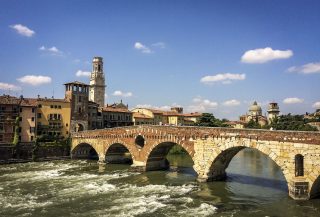
- Ponte Pietra: Verona's most photogenic river crossing, ideal for pairing the old town with scenic views and a gentle uphill viewpoint walk.
The Arena di Verona appears in our Complete Guide to Visiting Verona!

Moira & Andy
Hey! We're Moira & Andy. From hiking the Camino to trips around Europe in Bert our campervan — we've been traveling together since retirement in 2020!
This website uses affiliate links which may earn a commission at no additional cost to you!
Planning Your Visit
Tuesday - Sunday: 09:00-19:00. Closed on Mondays;
€12 (standard); €9 reduced; €3 ages 18-25; free for under-18s and other eligible categories (including VeronaCard holders).
Nearby Attractions
- Piazza Brà (0.1) km
Square - Porta Borsari (0.3) km
Historic Building - Arco dei Gavi (0.4) km
- Juliet's House (0.5) km
Historic Building - Piazza Delle Erbe (0.5) km
Square - Torre dei Lamberti (0.5) km
Tower - Castelvecchio Museum (0.5) km
Castle and Museum - Ponte Scaligero (0.6) km
Bridge - Piazza dei Signoria (0.6) km
Square - Loggia del Consiglio (0.6) km
Historic Building