Archbishop's Chapel of St. Andrew, Ravenna
Church in Ravenna
Tucked upstairs inside the Archbishop's Museum, the Archbishop's Chapel of St. Andrew feels like one of Ravenna's best-kept secrets. You don't arrive here by wandering into a grand piazza or spotting a bell tower; you reach it by stepping into a museum building and climbing to a small, jewel-like oratory that seems designed for quiet contemplation rather than crowds.
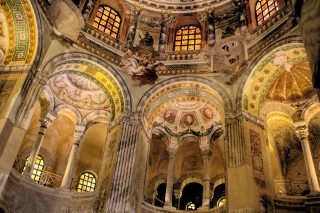
The payoff is immediate once you enter: compact walls and vaults alive with mosaics that glow in close quarters, making the experience feel personal and focused. If you're building a UNESCO itinerary beyond the headline monuments, this is one of the top sights in Ravenna, and it's often visited on walking tours of Ravenna because it sits in the historic centre and fits neatly between the larger basilicas.
Table of Contents
- History and Significance of the Archbishop’s Chapel of St. Andrew
- Things to See and Do in the Archbishop’s Chapel of St. Andrew
- Practical Tips on Visiting the Archbishop’s Chapel of St. Andrew
- Where to Stay close to the Archbishop’s Chapel of St. Andrew
- Is the Archbishop’s Chapel of St. Andrew Worth Visiting?
- FAQs for Visiting Archbishop’s Chapel of St. Andrew
- For Different Travelers
- Nearby Attractions to the Archbishop’s Chapel of St. Andrew
History and Significance of the Archbishop’s Chapel of St. Andrew
The chapel was built in the early 6th century under the patronage of Bishop Peter II, during the period when Theodoric ruled Ravenna. Its significance begins with what it represents: a private Catholic oratory functioning under a court where Arian Christianity held official status. In that context, the chapel becomes more than a devotional space-it is a statement of identity, resilience, and doctrinal clarity expressed through art.
After Byzantine control of Ravenna, the chapel was rededicated to Saint Andrew, whose relics are said to have arrived from Constantinople around the mid-6th century. That rededication underscores how closely Ravenna's sacred spaces tracked political realignment, but the chapel's voice remains consistent: its decorative programme is a deliberate hymn to the Saviour with an unmistakably Orthodox message.
Unlike Ravenna’s large public basilicas, this is a small-scale interior built for bishops and private worship. That intimacy is part of why it feels so powerful today. You are standing in a space where imagery was meant to speak directly and confidently, and where every motif reinforces Catholic orthodoxy in a city shaped by competing Christian interpretations.
Things to See and Do in the Archbishop’s Chapel of St. Andrew
Because the chapel is small, the best way to visit is to slow down immediately. Let your eyes travel across the surfaces rather than rushing toward a single focal point. The mosaic programme is dense, and in a compact space you notice how patterns, figures, and symbols are arranged to surround you rather than sit at a distance.
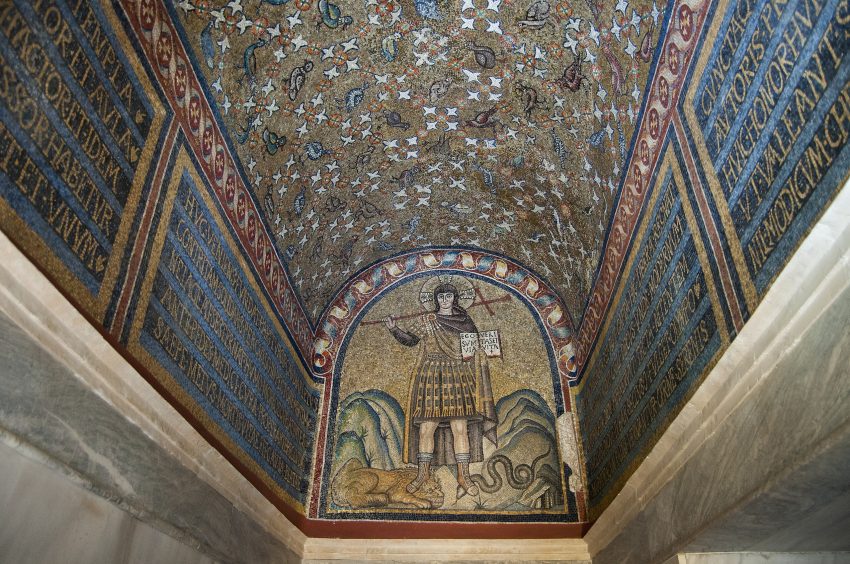
Look for the strong portrayal of Christ that runs through the imagery, including the striking representation of Christ as a warrior carrying a cross, and the repeated use of monograms and facial imagery that reinforce authority and doctrine. This is not a gentle, purely pastoral visual language; it is confident and purposeful, and it's part of what makes the chapel feel different from other Ravenna interiors.
Pay attention to the supporting cast of sacred figures-martyrs, apostles, and evangelists-who form a community of witness around the central message. In a private oratory setting, these figures feel less like “gallery images” and more like a theological environment: they create a sense of glorification and affirmation that aligns with the chapel’s anti-Arian interpretation.
Before you leave, linger in the vestibule long enough to notice the famous Latin inscription about light. Even without translating every word in detail, you can feel what it’s trying to do: claim radiance, truth, and freedom for Orthodox belief, using the brilliance of the mosaics as a visual proof.
Practical Tips on Visiting the Archbishop’s Chapel of St. Andrew
- Suggested tips: Treat it as a “quiet highlight” and visit when your energy is good, because the small space rewards attention and close looking.
- Best time to visit: Early in the day or midweek, when the museum is calmer and you can stand inside without being hurried along.
- Entrance fee: €10.50 - The ticket is cumulative only and includes: the Basilica of Sant'Apollinare Nuovo, the Neonian Baptistery (**), the Basilica of San Vitale, the Mausoleum of Galla Placidia (**), the Museum and the Archbishop's Chapel.
- Opening hours: Every day: 9.00 – 19.00
- Official website: http://www.ravennamosaici.it/
- How long to spend: 30-60 minutes for the museum and chapel combined; 10-20 minutes in the chapel itself if you want a proper, unhurried look.
- Accessibility: The chapel is on an upper level, so stairs or lift access will determine feasibility; check current accessibility arrangements if needed.
- Facilities: As a museum-based visit, expect basic visitor services nearby in the centre; plan cafés and longer breaks in the surrounding streets.
- Photography tip: If photography is permitted, avoid flash and focus on one or two well-composed shots; low light and reflective mosaic surfaces make quick photos less satisfying than slow viewing.
- Guided tours: A guide is particularly helpful here because the chapel’s meaning is tied to Orthodox versus Arian context, and a short explanation makes the imagery far more readable.
- Nearby food options: This is an easy stop to combine with lunch or aperitivo in the centre, since you’re only a short walk from Ravenna’s main café streets.
Where to Stay close to the Archbishop’s Chapel of St. Andrew
To keep the chapel and the wider UNESCO cluster walkable, stay in central Ravenna where you can move between museums, basilicas, and evening restaurants without relying on transport. Albergo Cappello is a strong choice for a characterful, central base close to the main sights. Hotel Centrale Byron is a practical option for keeping everything on foot, including the museum area. If you prefer a slightly more polished hotel feel while staying central, Palazzo Bezzi Hotel works well for a monument-focused itinerary.
Is the Archbishop’s Chapel of St. Andrew Worth Visiting?
Yes, especially if you want to see Ravenna’s mosaics in a more intimate setting than the city’s famous basilicas. The chapel is small, but that closeness is the entire point: the mosaics feel immediate, surrounding you with colour and meaning in a way that larger spaces sometimes dilute.
It's also one of the most intellectually rewarding visits in Ravenna because the imagery is so clearly shaped by theological tension. Even a brief stop can sharpen your understanding of the city's Arian and Orthodox layers, and it gives you a powerful “in-between” experience that complements the bigger monuments rather than competing with them.
FAQs for Visiting Archbishop’s Chapel of St. Andrew
What Other Travellers Say...

The Archbishop's Chapel of St. Andrew at P.za Arcivescovado 1 in Ravenna is a small, jewel-like chapel inside the archiepiscopal museum famed for its rich, finely crafted mosaics; visitors note its compact size and limited viewing time (typically five minutes per person) that helps preserve the interior, and many say the intimate, contemplative space—decorated with scenes and symbols across vaulted mosaics—makes it a must-see even if you weren't planning to visit the museum.


For Different Travelers
Families with Kids
This can be a good family stop if you keep it brief and visual. Because the chapel is compact, children don’t need to walk far to see the “main thing,” and you can turn the visit into a quick challenge: spot Christ, spot repeated symbols, and notice how the space is entirely covered in decoration.
Plan it as a calm, short indoor moment between more open-air walking sections. If your children are sensitive to quiet rules, visiting at a less busy time helps you move at your own pace without feeling pressured.
Couples & Romantic Getaways
For couples, this is one of Ravenna’s most intimate mosaic experiences, precisely because it is tucked away and small. The chapel feels like a discovery, and it naturally encourages a slower, shared pace of looking and noticing.
It also pairs nicely with a gentle day plan: museum and chapel in the late morning, then a long lunch and an unhurried walk through the centre. The contrast between hidden interior brilliance and ordinary city streets outside is part of the charm.
Budget Travelers
This is a strong value visit if you are already planning to pay for a few key entries in Ravenna, because it adds a UNESCO mosaic highlight without requiring a separate destination or transport. You can build it into a walkable route and keep your day efficient.
If you’re prioritising, consider it a “high impact per minute” stop: a small space, a big artistic payoff, and a deeper layer of Ravenna’s religious history.
History Buffs
History-focused travellers often find this chapel exceptionally rewarding because the imagery is tightly bound to doctrinal politics. The anti-Arian interpretation, the strong Christ-as-warrior motif, and the surrounding community of martyrs and evangelists all function as theological argument as much as decoration.
It's also a useful complement to visits connected with Theodoric's era, because it shows how Catholic identity persisted and expressed itself within a city shaped by competing Christian traditions. Few places in Ravenna communicate that tension so clearly in such a concentrated form.
Nearby Attractions to the Archbishop’s Chapel of St. Andrew
- Basilica of San Vitale: Ravenna's most celebrated interior, where imperial-era mosaics dominate the presbytery and apse.
- Mausoleum of Galla Placidia: A small building with a starry dome mosaic and a uniquely intimate atmosphere.
- National Museum of Ravenna: A monastery-based museum with archaeology, Byzantine sculpture, ivories, and applied arts beside San Vitale.
- MAR – Ravenna Art Museum: A contemporary-focused museum in a Renaissance cloister, especially strong for modern mosaics.
- Dante's Tomb: A quiet memorial stop in the city centre, perfect for a reflective pause between major sights.
The Archbishop's Chapel of St. Andrew appears in our Complete Guide to Visiting Ravenna!

Moira & Andy
Hey! We're Moira & Andy. From hiking the Camino to trips around Europe in Bert our campervan — we've been traveling together since retirement in 2020!
This website uses affiliate links which may earn a commission at no additional cost to you!
Planning Your Visit
Every day: 9.00 - 19.00
€10.50 – The ticket is cumulative only and includes: the Basilica of Sant’Apollinare Nuovo, the Neonian Baptistery (**), the Basilica of San Vitale, the Mausoleum of Galla Placidia (**), the Museum and the Archbishop’s Chapel.
Nearby Attractions
- Archbishop's Museum (0.0) km
Museum - Neonian Baptistery (0.1) km
Baptistery - Ravenna Cathedral (0.1) km
Cathedral - Basilica of San Francesco (0.3) km
Basilica - Dante’s Tomb (0.3) km
Tomb - Museo Dante (0.3) km
Historic Building and Museum - Piazza del Popolo (0.4) km
Square - Domus dei Tappeti di Pietra (0.5) km
Historic Site and Museum - Arian Baptistery (0.6) km
Baptistery - National Museum of Ravenna (0.6) km
Historic Building and Museum