Aqueduct of the Gier, Lyon
Roman Site in Lyon
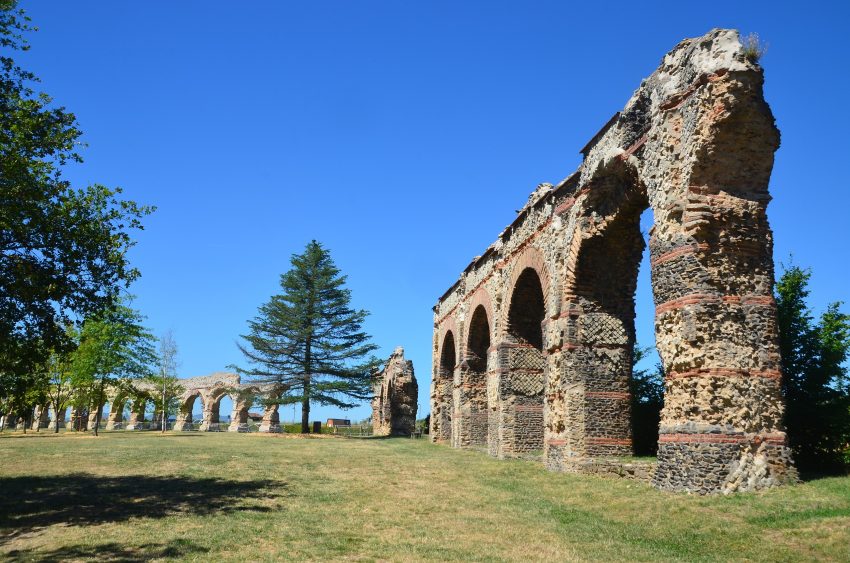
The Aqueduct of the Gier is one of the things to do in Lyon if you love Roman history, engineering, or off-the-beaten-path discoveries. Built in the 1st century AD to supply water from the Gier River to Lugdunum, it once stretched around 85 km, threading its way across hills, valleys, tunnels, and buried channels to reach the capital of Gallia Lugdunensis. Today you can still see striking fragments of this system in places like Chaponost and Sainte-Foy-lès-Lyon, where lonely lines of arches cut across fields and suburban streets, quietly telling the story of a city that needed serious infrastructure to match its ambitions.
What makes the Aqueduct of the Gier so fascinating is how sophisticated it was. Engineers followed a tiny slope of around 0.1% to keep the water flowing, buried long stretches in covered ditches, and pierced the landscape with tunnels and access shafts. Most impressive of all were the inverted siphons that carried water across deep valleys using pressurised lead pipes and high arched bridges. Standing by the remaining piers and channels today, you get a real sense of how much planning and precision went into this single project, which only began to serve the city once every last section was complete. It is often visited Roman tours around Lyon that connect the aqueduct with the theatres and museum on Fourvière Hill.
Table of Contents
- History and Significance of the Aqueduct of the Gier
- Things to See and Do in the Aqueduct of the Gier
- How to Get to the Aqueduct of the Gier
- Practical Tips on Visiting the Aqueduct of the Gier
- Where to Stay close to the Aqueduct of the Gier
- Is the Aqueduct of the Gier Worth Visiting?
- FAQs for Visiting Aqueduct of the Gier
- Nearby Attractions to the Aqueduct of the Gier
History and Significance of the Aqueduct of the Gier
The Aqueduct of the Gier was likely completed around the mid-1st century AD, when Lugdunum was thriving as the political and commercial centre of Gallia Lugdunensis. Drawing its water from the Gier River on the slopes of Mont Pilat about 42 km southwest of the city, the aqueduct actually followed a much longer looping route of around 85 km to maintain a gentle, reliable gradient. Early scholars once dated it to the 2nd century and linked it to Hadrian, but more recent evidence from architectural style and associated fountains in Lyon points firmly to an earlier construction date.
As one of four major aqueducts serving Lugdunum, the Gier line was the longest and best-preserved, and probably one of the most important in terms of capacity. Of its length, the vast majority ran in covered channels, some buried several metres underground to protect the water from contamination and temperature extremes. At regular intervals, vertical shafts were sunk to the surface to allow maintenance workers to access and clean the conduit-evidence of Roman understanding that even the most elegant hydraulic system needed ongoing care.
The aqueduct's most technically ambitious elements were its inverted siphons, which allowed the line to cross deep valleys like those of the Garon and Trion rivers without detouring for kilometres. Instead of building endless rows of arches to stay at the same level, Roman engineers dropped the flow down one side of the valley, ran it across the bottom in pressurised pipes, and pushed it back up the other side. The surviving piers and bridge elements that once supported these pipes give the Aqueduct of the Gier much of its visual impact today and still serve as textbook examples of Roman hydraulic engineering.
Things to See and Do in the Aqueduct of the Gier
The Aqueduct of the Gier is not a single, fenced-off site but a chain of remains scattered through villages and countryside southwest of Lyon, with Chaponost being one of the best places to see substantial stretches. Here, long lines of stone arches rise above fields, echoing the rhythm of the buried channel that once ran along their tops. A walk along the footpaths near these arches lets you appreciate the scale and alignment of the structure and how carefully it followed the contours of the land.
In Sainte-Foy-lès-Lyon and other nearby communes, you can spot additional fragments integrated into modern settings: short sections of wall, channels, or piers tucked behind houses or beside roads. These glimpses are particularly evocative because they show how the aqueduct still shapes the landscape centuries after it stopped flowing. With a bit of advance research or a local map, you can turn these pieces into a mini treasure hunt across the hills, connecting one viewpoint to the next.
If you're especially interested in the technical side, focus on areas where the remains of the inverted siphons and their bridge supports can be seen. The difference between the buried channels, the vaulted galleries, and the lofty piers makes it easier to visualise how the system coped with different kinds of terrain. Combined with a visit to Lyon's Gallo-Roman Museum on Fourvière Hill, which helps explain the citywide network of aqueducts and fountains, your time at the Aqueduct of the Gier becomes a deep dive into the water supply of ancient Lugdunum.
How to Get to the Aqueduct of the Gier
Most visitors arriving from abroad will land at Lyon-Saint Exupéry Airport (LYS), which has regular flights from across Europe and beyond; from the airport, the Rhônexpress tram brings you into central Lyon, where you can connect to regional trains, trams, or buses heading towards the southwestern suburbs and villages like Chaponost. For the best deals and a seamless booking experience, check out these flights to Lyon on Booking.com.
From Lyon Part-Dieu or Lyon Perrache stations, regional TER services or local trains can take you towards towns in the direction of Givors and the Mont Pilat foothills, with onward bus or walking connections to spots where the aqueduct remains are visible; alternatively, local buses from Lyon can bring you directly to Chaponost or Sainte-Foy-lès-Lyon, from which it's a short walk to key viewing points. You can use SNCF Connect to check schedules, compare routes, and purchase tickets for National (SNCF ) and regional trains (TER). For a more streamlined experience, we recommend using Omio, which allows you to easily compare prices, schedules, and book tickets for both National and Regional travel across all of Europe, all in one place.
If you're travelling by car, follow signs from Lyon towards Saint-Étienne or Givors, then branch off for Chaponost, Mornant, or Sainte-Foy-lès-Lyon depending on which section you'd like to see. If you are looking to rent a car in France I recommend having a look at Discover Cars, first, as they compare prices and review multiple car rental agencies for you. Having a car makes it easier to link several viewpoints in one day, but even with a vehicle you’ll want comfortable shoes for short walks along field paths and village streets.
Practical Tips on Visiting the Aqueduct of the Gier
- Suggested tips: Bring a printed map or offline route notes, as some aqueduct sections are poorly signposted and easier to find if you’ve marked them in advance.
- Best time to visit: Late spring, early autumn, and clear winter days are ideal; cooler temperatures and soft light make walking between the arches more pleasant and photogenic.
- Entrance fee: Free — most remains are outdoors and accessible from public paths or roads.
- Opening hours: Accessible in daylight hours; specific paths or viewpoints may follow local park or path regulations.
- How long to spend: Allow 1-3 hours depending on how many sections you want to see and whether you’re walking circular routes or just making short stops.
- Accessibility: Terrain varies from village pavements to rough field tracks; some viewpoints are suitable for most visitors, while others may be challenging for those with reduced mobility.
- Facilities: Facilities are limited at the remains themselves, but nearby villages offer cafés, bakeries, toilets, and small shops for snacks and water.
- Photography tip: Use the repeating arches to create strong leading lines in your compositions; shoot in the early morning or late afternoon for side light that emphasises texture.
- Guided tours: Look out for guided walks or themed outings offered by local tourist offices, which can provide extra context and make it easier to locate the most interesting sections.
- Nearby food options: Combine your visit with lunch in Chaponost, Sainte-Foy-lès-Lyon, or another nearby village, where you'll find local restaurants and bistros perfect for a post-walk meal.
Where to Stay close to the Aqueduct of the Gier
If you’d like a base in the countryside near the aqueduct arches, Le Saint Vincent offers a convenient location southwest of Lyon, making it easy to reach Chaponost and other viewing points while still being within driving distance of the city.
For a stay that balances access to the aqueduct with city comforts, ibis Lyon Centre Perrache places you near Lyon-Perrache station and main road routes heading towards the Mont Pilat area. From here, you can take a half-day trip out to the aqueduct and return in time for dinner in the Presqu'île.
Another option is Novotel Lyon Confluence, located at the southern tip of the Presqu'île. With quick road access to the southwest and easy links back into central Lyon, it works well if you want to pair a modern riverside stay with a day exploring Roman engineering in the surrounding countryside.
Is the Aqueduct of the Gier Worth Visiting?
The Aqueduct of the Gier is absolutely worth visiting if you enjoy Roman history, engineering, or scenic walks through semi-rural landscapes. It won't give you a single, polished visitor centre, but instead a series of atmospheric fragments that invite you to imagine the full 85 km network that once brought water to Lugdunum. Seen in combination with Lyon's Roman theatres and museum, it rounds out the picture of a city that invested heavily in infrastructure and comfort, and it offers a rewarding, quieter counterpart to more central sights.
What Other Travellers Say...

Gier Roman Aqueduct, at 40 Rte des Pins in Chaponost, is an impressive, largely intact remnant of Roman engineering set in a pleasant spot for a short walk or a shady rest; visitors note its remarkable age and craftsmanship and often stop to admire the surviving structure.


FAQs for Visiting Aqueduct of the Gier
Nearby Attractions to the Aqueduct of the Gier
- Parc des Hauteurs - A series of paths and terraces along the ridge of Fourvière, ideal for linking Roman sites with viewpoints over the Saône and Rhône valleys.
- Ancient Theatre of Fourvière - Lyon's grand Roman theatre on Fourvière Hill, once seating thousands and still used for performances today.
- Odeon of Lyon - A smaller, more intimate Roman performance space beside the main theatre, designed for music and recitations.
- Gallo-Roman Museum of Lyon-Fourvière - An excellent museum explaining Lugdunum's history, including its aqueducts and urban water network.
- Basilica of Notre-Dame de Fourvière - The hilltop basilica overlooking Lyon, offering sweeping views and a striking contrast to the city's Roman past.
The Aqueduct of the Gier appears in our Complete Guide to Visiting Lyon!

Moira & Andy
Hey! We're Moira & Andy. From hiking the Camino to trips around Europe in Bert our campervan — we've been traveling together since retirement in 2020!
This website uses affiliate links which may earn a commission at no additional cost to you!
Planning Your Visit
Accessible in daylight hours; specific paths or viewpoints may follow local park or path regulations.
Free - most remains are outdoors and accessible from public paths or roads.
Nearby Attractions
- Aquarium (4.4) km
Aquarium - Le Cube Orange (4.7) km
Notable Building - Musée des Confluences (4.7) km
Museum - Tomb of Turpio (5.8) km
Roman Site - Ancient Baths of Lyon (6.2) km
Roman Site - Odeon of Lyon (6.3) km
Roman Site - Ancient Theatre of Fourvière (6.4) km
Roman Site - Abbaye Saint-Martin d’Ainay (6.4) km
Abbey - Gallo-Roman Museum of Lyon-Fourvière (6.4) km
Museum - Basilica of Notre-Dame de Fourvière (6.7) km
Basilica